Tuesday, May 8, 2018

The Kalo Shop was the "leading maker" of the Arts and Crafts silver movement in Chicago.

In many respects the Kalo Shop was the single most important American handwrought silversmith. The Kalo Shop produced the widest range of classic handmade holloware, jewelry, and flatware for nearly 70 years, and was a critical influence in the Arts & Crafts movement.

The Kalo shop and affiliated Kalo Arts and Crafts Community House, a training school and workshop noted for silver and jewelery in nearby Park Ridge, Illinois, were founded in 1900 by a group of six young women who had trained at the Art Institute of Chicago.

Thirty-two year old Clara Pauline Barck (1868-1965) was the group's leader and most notable member. The other founders were: Bertha Hall, Rose Dolese, Grace Gerow, Ruth Raymond, and Bessie McNeal.

The Kalo company name was taken from a Greek word meaning "to make beautiful."

In addition to pyrography (the art or technique of decorating wood or leather by burning a design on the surface) and leatherwork, Barck initially sold textiles, copper items, baskets, and jewelry. In 1905, Barck married George Welles, a coal merchant and amateur silversmith.


In 1907 she bought a house to serve as the workshop for the Kalo Arts Crafts Community in Park Ridge.
The Kalo Shop metalsmiths, jewelers, designers and crafts workers seated in front of the Kalo Arts Crafts at 255 North NW Highway in Park Ridge, Illinois. circa 1910
When Clara and George divorced in 1914 and the Shop moved to Chicago at 222 South Michigan Avenue, George convinced her to focus exclusively on the handwrought copper and silver items for which it is best known. In 1912 Kalo opened a branch store in New York that lasted only until 1916 because of war constraints.
Kalo Shop, 152 East Ontario Street, Chicago. circa 1924
In 1959, Barck transferred the shop to four of the craftsmen; Robert Bower, Daniel Pederson, Arne Myhre, and Yngve Olsson. Barck hired women designers almost exclusively, although the immigrant Scandinavian craftsmen were male. At its peak, Kalo employed 25 silversmiths.

After Barck retired, the Shop continued making copies of the early pieces, adding a few modernist items and some in the Danish taste.  Many of its forms are classics, and very collectible, reflecting Welles' motto:  "Beautiful, Useful, Enduring." Kalo closed in 1970 due to the difficulty of finding young people willing to apprentice as silversmiths.

In the summer 1992 issue of American Silversmith, Bower, the last, surviving Kalo silversmith, explained to an interviewer that, "We ran out of silversmiths. In the last year we lost our three top silversmiths; men who could not be replaced. It was difficult trying to find men willing to learn silversmithing and it took years to train them."

Today, Kalo pieces bring high prices at auction and belong to the collections of major museums.
Large early Kalo coffee urn from the shop's Park Ridge studio.
Compiled by Neil Gale, Ph.D. 

Frederick W. Job, Attorney and Secretary of the Chicago Employer's Association.

The Frederick W. Job (rhymes with 'robe') residence at 4575 South Oakenwald Avenue, Chicago, was built in 1897 by Pond & Pond Architects. Mr. Job was an Attorney and Secretary of the Chicago Employer's Association and the Chairman of Arbitration for the State of Illinois. His office was in the Marquette Building at 56 West Adams Street, Chicago.
Frederick W. Job residence at 4575 South Oakenwald Avenue, Chicago 

From the July-December 1902 book, "The World To-Day" a monthly record of human progress.

A splendid success was achieved during the first week in June for the policy of conciliation by the settlement of two dangerous strikes in Chicago. Teamsters employed by the large packers to deliver meats to local markets struck for an increase in wages and other substantial benefits. Efforts on the part of the packers to supply the city with meat by sending out their wagons in long caravans furnished with a strong police guard led to terrible street riots, extending for miles through the heart of the city and resulting in the killing of a few persons and the serious injury of many. In the meantime, members of the arbitration committee of the National Civic Federation and Frederick W. Job, chairman of the Illinois Board of Arbitration, used their best endeavors to secure a peaceful settlement of the bloody war. Mr. Job, by patient endeavor, first succeeded in bringing together representatives of the department store managers of the city and of the drivers of their delivery wagons, who had struck in a body because two of their number had been discharged for refusing to haul meats from the packing houses during the teamsters' strike.
Frederick W. Job
This meeting led to an agreement between drivers and employers, arrived at by mutual concessions, and the drivers returned to work. Mr. Job then turned his attention to the greater strike of the stockyards teamsters. After a long day of rioting and bloodshed in the principal streets of the city, a night of negotiation, made possible by the tact and address of the chairman of the arbitration board, who had brought together representatives of the Packers and of the Teamsters' union, resulting in a harmonious settlement of the strike. The intense relief of the community, which for some days had been on the verge of a meat famine and which had seen the streets turned into battlefields, expressed itself in enthusiastic praise of the policy of conciliation invoked with such skill by Chairman Job. Seldom has a more impressive lesson Teamsters’ Strike in Chicago been given of the superiority of reason over sullen non-intercourse on one side and brute violence on the other.


Compiled by Dr. Neil Gale, Ph.D. 

Monday, May 7, 2018

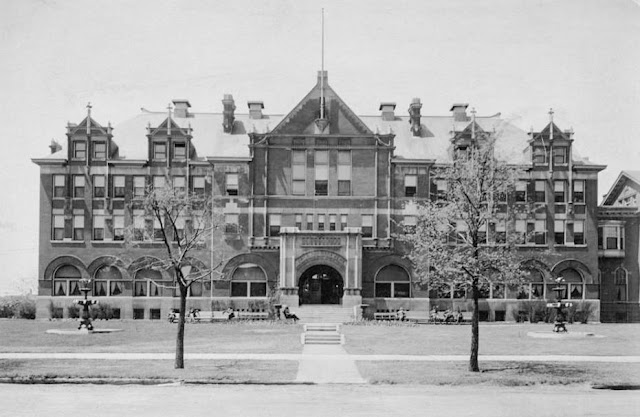
The Chicago Home for Aged Jews was established on the South Side in 1891.

The Chicago Home for Aged Jews was established on April 6, 1891 with Morris Rosenbaum as prendent, at 6140 South Drexel Avenue at 62nd Street (the northwest corner) to serve the German-Jewish community. Abraham Slimmer of Waverly, Iowa, donated $50,000 for such a home in Chicago, on condition that the Jews of Chicago raise an equal amount. The money was obtained without difficulty.
The Home for Aged Jews was dedicated and opened Sunday, April 30, 1893 and at the end of the year the number at the home was 44.

The building was demolished in 1959 for construction of a north wing addition to the 1950 expansion (by then renamed Drexel Home and which is now known as the Drexel Terrace Apartments).

Compiled by Neil Gale, Ph.D.