
Friday, August 11, 2023

Automobile Polo was played at Chicago's Comiskey Park on June 5, 6, 7, and 8, 1913.

Chicago Tribune, Monday, July 28, 1902.
The newest twentieth-century game is called automobile polo. The name, however, has already been found too long and has been conveniently abbreviated to "auto polo." An interesting exhibition of auto polo was given last week on the field of the fashionable Dedham Polo Club of Boston. Mr. Joshua Crene Jr., a member of this club and an expert polo player, made a series of polo strokes from his automobile to the amazement of polo enthusiasts. Mr. Crane is a clever all-around athlete and adept at handling an automobile as well as a polo mallet.

The play is executed so quickly that an unpracticed eye has difficulty following it. The nimble little mobile machines used in the game are capable of developing a speed of about forty miles an hour in a few feet and can be brought to a standstill practically within their own lengths.

Auto polo was a dangerous but popular motorsport that originated in the United States in 1911. It was similar to equestrian polo, but instead of horses, players used cars. The sport was played at fairs, exhibitions, and sports venues across the United States and Europe until the late 1920s. Auto polo was dangerous because of the high speeds and the risk of collisions. Players and spectators were often injured or killed, and vehicles were often damaged.
Auto Polo played at Chicago's Comiskey Park on June 5, 6, 7, and 8, 1913.


Almost as soon as automobiles became somewhat practical, people were figuring out dangerous and fun things to do with them.

The earliest automobiles were typically rich folks’ novelties, which may explain why, in 1902, Joshua Crane, Jr., a polo enthusiast active with the Dedham Polo Club of Boston, decided to put on an exhibition polo match wherein Mobile Runabouts replaced horses.

That it might not have been the safest endeavor can be seen from a surviving photograph of the match catching one of the drivers/mallet men doing a header into the ground, about to be run over by his own steed.

Chicago Tribune, Friday, June 5, 1913
Chicago will get its first taste of auto polo on June 5 when a four days series between teams representing Chicago and New York will be started at Comiskey Park. A syndicate of Chicago men is promoting contests. The first game will be played on the afternoon of June 5, followed by another at night, then by others as follows: The afternoon and night of June 6, the night of June 7, and afternoon and night of June 8.


Just exactly how dangerous it was is hard to tell. The risk of injury to both competitors and spectators eventually put an end to the practice in the late 1920s, but a contemporary account says that deaths were rare. It’s clear that some of the danger might have been exaggerated by staged photographs, but broken bones were apparently not uncommon. In some photos, it seems that competitors wore leather football helmets, showing there was at least some concern about safety.

Though Mr. Crane put on the first auto polo match, it was a Topeka, Kansas, Ford dealer who turned it into an organized sport.

Ralph “Pappy” Hankinson saw polo with cars as a way of promoting the sale of the Model T. The first match Hankinson organized took place in an alfalfa field near Wichita on July 20, 1912, with four cars, eight players, and a reported crowd of 5,000 spectators. Each car carried a seat-belted driver and a free-standing mallet man who had to hang on—often unsuccessfully. The ball was the size of a basketball (some accounts say it was, in fact, a basketball), and after learning something about physics and inertia, weights were added to the mallets so they didn’t “backfire” when striking the balls. Stripped-down Model Ts were fitted with crude roll bars to protect the driver and the cars’ radiators. Speeds were not high, never more than 35 mph, but high enough for mayhem.


Auto polo was invented before the radio, let alone television, so it shouldn’t be a surprise that Hankinson’s idea quickly caught on. Under the Auto Polo Association, local leagues were founded across the United States, and a large exhibition of the sport was staged in Washington, D.C.’s League Stadium in November 1912.

Hankinson sent exhibition teams to England, Europe, and even the Philippines to promote the sport. In 1913, auto polo became the first motorsport to be featured at the Canadian National Exhibition. Britain’s The Auto magazine was impressed but described it as a “lunatic game” that they hoped would not catch on in the UK.

By the 1920s, New York City and Chicago were hosting daily auto polo matches, with some of the games played at NYC’s famous Madison Square Garden.


Many car racing fans today disavow their interest in crashes, but that was genuinely part of the appeal of auto polo. By the end of the matches, the cars were either severely damaged or completely demolished. Hankinson’s own accounting of damages to the cars used by his British and American auto polo teams in 1924 lists 1,564 broken wheels (most cars used wooden spoked “artillery” wheels), 538 unusable tires, 66 broken axles, 10 cracked engines and 6 completely destroyed cars.

While injuries to competitors were frequent, and even spectators were not infrequently hurt by balls flying into the stands or runaway cars, it appears that economics, not concerns about safety, put an end to auto polo.

According to the book Bain’s New York: The City in News Pictures 1900-1925, as the 1920s wore on, the cost of fixing and replacing the cars became too costly. By then, organized car racing was well established. If that wasn’t dangerous enough, there were board-track motordromes and walls of death. So as dangerous as auto polo must have been, it might have seemed a bit quaint during the Roaring Twenties.

In any case, auto polo was a real thing—loony but real.
Auto Polo—No car but the Model T Ford of the
early 1900s had the forward and reverse speeds
and brakes applied by foot pedals. The throttle was
operated by hand, and it was the transmission
system that made such maneuvers possible.

The Dedham Polo Club first used Mobile Runabouts for their exhibition games in 1902. 
1902 Stanley Stick-Seat Runabout.


Unlike equestrian polo, which requires large, open fields that can accommodate up to eight horses at a time, auto polo could be played in smaller, covered arenas during wintertime. This factor greatly increased its popularity in the northern United States. The game was typically played on a field or open area that was a least 300 feet long and 120 feet wide, with 15-foot wide goals positioned at each end of the field. The game was played in two halves (chukkers), and each team had two cars and four men in play on the field at a given time.
The first auto polo cars used by the Dedham Polo Club were unmodified, light steam-powered Mobile Runabouts that seated only one person and cost $650 ($22K today). 


As the sport progressed, auto polo cars resembled stripped-down Model T's. Usually, they did not have tops, doors or windshields, with later incarnations sometimes outfitted with primitive rollbars to protect the occupants. Cars typically had a seat-belted driver and a mallet man that held on to the side of the car and would attempt to hit a regulation-sized basketball toward the goal of the opposing team, with the cars reaching a top speed of 40 miles per hour and while making hairpin turns. The mallets were shaped like croquet mallets but had a three-pound head to prevent "backfire" when striking the ball at high speeds.

The Truth About Cars
Edited by Dr. Neil Gale, Ph.D.

Thursday, August 10, 2023

Untenable Theories About Lincoln's Childhood Environment.


The following excerpts present Abraham Lincoln's parents and his early home life in an unfavorable light. The stigma which has rested on the President's pioneer father and the exaggerated conditions existing in the early Lincoln home is not in harmony with documentary evidence:
  • "The old gentleman [Thomas Lincoln] was not only void of energy but dull." Herndon. Lincoln, pg 6.
  • "No more ignorant boy than Thomas could be found in the back woods." Beveridge. Abraham Lincoln, pg 12.
  • "The whole house squalid, cheerless, and utterly void of elevating inspiration." Schurz. Abraham Lincoln, pg 12.
  • "Here was the home, and here were its occupants, all humble, all miserably poor." Holland. Life of Abraham Lincoln, pg 23.
  • "He  [Thomas Lincoln] was no toiler but from all accounts an ignorant, shiftless vagabond." Coleman. The Sad Story of Nancy Hanks, pg 8.
  • ''It was here that Abraham Lincoln was born. The manger at Bethlehem was not a more unlikely birthplace." Sheppard. Abraham Lincoln, pg 8.
  • "He [Thomas Lincoln] was a shiftless fellow, never succeeding in anything, who could neither read nor write." Stephenson. Lincoln, pg 8.
  • "Reared in gripping, grinding, pinching penury, and pallid poverty, and the most squalid destitution possible to conceive." Peters. Abraham Lincoln's Religion, pg 3
  • "Lincoln was born in a degradation very far below respectable poverty in the State of Kentucky and lived in that poverty all his life." Chafin. Lincoln. Man of Sorrows, pg 10.
  • "In the midst of the most unpromising circumstances that ever witnessed the advent of a boy into the world," Nicolay & Hay. Abraham Lincoln, A History, Vol 1, pg 25.
  • "Nobody ever accused him [Thomas Lincoln] of building a house or to pretend to do more than a few little odd jobs connected with such an undertaking." Lamon. Life of Lincoln, pg 9.
  • "The father was called a carpenter but not good at his trade, a shiftless, migratory squatter by invincible tendencies and a very ignorant man." Morse, Abraham Lincoln, Vol 1, pg 10.
  • "Thomas seems to have been the only member of the family whose character was not respectable. He was an idler, trifling, poor, a hunter, and a rover." Lamon. Life of Lincoln, pg 8.
  • "In childhood and youth, his [Abraham Lincoln's] intimate associates and putative relatives a gross, illiterate, and superstitious rabble." Cathey. True Genesis of a Wonderful Man, pg 193.
  • "Thomas Lincoln never prospered like Josiah and Mordecai (biblical) and never seemed to have left the impression of his goodness or of anything else on any man." Charnwood. Abraham Lincoln, pg 4.
  • "Thomas Lincoln, a poverty-stricken man whom misfortune had seemingly chosen for her own, and whose ambitions were blighted and hope almost dead." Peters. Abraham Lincoln's Religion, pg 3.
  • "There could hardly be a poorer family than that which now undertook to support its narrow, hopeless life in that dull corner of the earth's teeming surface." Stoddard. Abraham Lincoln, pg 11.
  • "He [Thomas Lincoln] reached the age of 27 the year of his marriage, a brawny, wandering laborer, a poor white, unlettered and untaught except for the trade of carpenter." Strunsky. Abraham Lincoln, pg 5.
  • "At the time of his [Thomas Lincoln] birth, twenty-eight years before, his parents—drifting, roaming, people, struggling with poverty—were dwellers in the Virginia mountains." Stephenson. Lincoln, pg 4.
  • "His [Abraham Lincoln's] father was an ignorant man, amiable enough, but colorlessly negative, without the strength of character and without ambitions worthy of the name." Hill. Lincoln the Lawyer, pg 6.
  • "Thomas Lincoln and Enlow had a regular set-to fight about the matter in which encounter Lincoln bit off the end of Enlow's nose. Finally, Lincoln, to clear himself, moved to Indiana." Weik. The Real Lincoln, pg 31.
  • "I never could understand how so great and good a man as old Abe could have descended from such a low breed and entirely worthless vagabond as Thomas Lincoln." Cathey. True Genesis of a Wonderful Man, pg 239.
  • "Thomas Lincoln was an ignorant, shiftless, worthless, illiterate man . . . he thought it a waste of time for young Abraham to learn to read and write as he could do neither." Chafin. Lincoln, Man of Sorrows, pg 11.
  • "So pained have some persons been by the necessity of recognizing Thomas Lincoln as the father of the President that they have welcomed a happy escape from this so miserable paternity." Morse. Abraham Lincoln, Vol 1, pg 7.
  • "But Lincoln rose from a lower depth than any of them. From a stagnant, putrid pool; like the gas which set fire by its own energy and self-combustible nature rises in jets blazing, clear, and bright." Herndon. Herndon's Lincoln, Vol 1, pg 9.
  • "Born not only in poverty, but surrounded by want and suffering; favored in nothing; wanting in everything which makes up the joys of life . . . it was literal truth that 'he had nowhere to lay a head.' " Cathey. True Genesis of a Wonderful Man, pg 255.
  • "The domestic surroundings under which the babe [Abraham Lincoln] came into life were wretched in the extreme. . . . Rough, course, low, ignorant, and poverty-stricken surroundings were about the child." Morse. Abraham Lincoln, Vol 1, pg 9.
  • "In childhood and youth, his [Abraham Lincoln's] place of abode a squalid cabin in a howling wilderness, his meal as an ashen crust, his bed a pile of leaves, his nominal guardian a shiftless and worthless vagabond." Cathey. True Genesis of a Wonderful Man, pg. 193
  • "His [Abraham Lincoln's] father was a typical 'poor Southern white,' shiftless and improvident, without ambition for himself or his children, constantly looking for a new piece of ground where he might make a living without much work." Schurz. Abraham Lincoln, pg 12.
  • "Abraham Lincoln came of the most unpromising stock on the continent, 'the poor white trash' of the south. His shiftless father moved from place to place in the western country, failing where everybody else was successful in making a living, and the boy spent the most susceptible years of his life under no discipline but that of degrading poverty." Woodrow Wilson. Division and Reunion, pg 216.
Elucidation
I'm well aware that historical accounts are written by people and can be slanted, so I try my hardest to present fact-based and well-researched articles. In this time period, rumors and innuendos have tainted the truth in "Lincoln" books, thus besmirching future writings.

Read my article debunking Thomas Lincoln being a boorish, poor idiot.

Compiled by Dr. Neil Gale, Ph.D.

Tuesday, August 8, 2023

World's First Nuclear Reactor at the University of Chicago.

THE BEGINNING
Construction of CP-1, or Chicago Pile Number One, was constructed under the University of Chicago's Stagg Field football stadium (1893–1957) in an abandoned squash court. Mankind first harnessed the energy of the atom on December 2, 1942. Fermi's pile produced only ½ watts of power. It constantly emits radiation.

Envisioned by famous physicist Enrico Fermi, CP-1 was a crude, ugly contraption of 330 tons of graphite bricks surrounding 5 tons of unrefined uranium metal. It had no shielding to protect the scientists operating it, but it was nonetheless a major breakthrough in developing nuclear weapons. Fermi successfully achieved a controlled atomic chain reaction.

Despite its crudeness, CP-1 was a major breakthrough in nuclear science. It showed that it was possible to produce a controlled nuclear chain reaction and paved the way for developing atomic weapons and nuclear power plants.

As the use of CP-1 improved, concern for the safety of its operators (and the thousands of nearby students) promoted a move a few miles to the west to the Cook County Forest Preserves, Lemont, Illinois, named 'Site A.'
Chicago Pile Number One or CP-1


The scientists dismantled CP-1, moved it to Site A, and reassembled it into a cube about 25 feet high and 30 feet on each base. This time, Fermi added a few safety elements. Five-foot concrete walls surrounded its sides. Six inches of lead and 50 inches of lumber acted as a lid.

sidebar
Site A is about 20 acres in size and contains the buried remains of Chicago Pile-1.
Plot M is 150x140 foot (21K sq. ft.) area that is the radioactive waste dumpsite.

This redesigned reactor was named Chicago Pile-2 (CP-2). It was still a crude device but much safer than CP-1. CP-2 was used for research on nuclear weapons and other applications of atomic energy.

A year later, CP-3 joined CP-2. CP-3 was a more advanced reactor that used heavy water (H³O+) instead of graphite to slow nuclear reactions. CP-3 was used for research on nuclear power plants.
"World's First Nuclear Reactor," followed by a summarized history of Argonne. Photo: Forest Preserves of Cook County, IL.


For a decade, scientists conducted hundreds of experiments using these primitive reactors. The experiments ranged from nuclear weapons to biomedical research to sustained atomic energy.

The work at Site A and Argonne National Laboratory (which grew out of the Metallurgical Laboratory at the University of Chicago) laid the foundation for the development of nuclear science and technology. 

The two reactors, CP-2 and CP-3, were shut down in 1954. The most radioactive and dangerous elements of the reactors were disposed of by the Oak Ridge Laboratory in Tennessee. 
U.S. Department of Energy, 1974.


The reactor was buried in 1954 an extremely deep hole, and the surrounding area was designated as a radioactive waste dumpsite.

In the 1940s and 50s, visitors to the Red Gate Woods often encountered well-armed military police. The MPs would question the confused strangers, check IDs, and search pockets. Then without an apology or explanation, the confused visitors would be ordered firmly to leave the area and not return.
RED GATE WOODS


In the early 1980s, amid the nuclear disasters at Three Mile Island and Chornobyl, the City of Chicago asked Greenpeace surveyors to test the burial grounds at Site A. The surveyors were horrified to find islands of radioactive elements dotting the Site. The City requested help from the federal government, but their request was denied. However, when the information about the radioactive contamination went public, there was an outcry from the community. People who had spent years strolling, picnicking, and riding horseback in the woods near Site A were outraged to learn that they had been exposed to dangerous radiation. 

The federal government eventually gave the City $30 million to fence off, analyze, and decontaminate the Site. A decade later, their efforts transformed Site A into a safe, recreational area where people can enjoy the outdoors without fear of radiation exposure. However, the Site is still monitored annually for radiation levels. 

The Legacy of Site A and Plot M is foremost a reminder of the early days of the nuclear age. It's a testament to the ingenuity of the scientists who developed the world's first atomic reactor. And most importantly, reminds us of the dangers of nuclear technology.

PUBLIC OUTCRY
In 1976, the public learned there was radioactive material in Red Gate Woods (Site A). The United States Department of Energy (DOE) released a report that found low levels of tritium in three wells in the area. Tritium is a radioactive isotope of hydrogen that is produced by nuclear reactors. The DOE concluded that the tritium likely came from Site A, which had been used for atomic research during World War II.

The DOE's report sparked a public outcry. The Illinois Department of Public Health (IDPH) conducted its own investigation and found that the wells' tritium levels were elevated but posed no immediate health risk to the public. However, the IDPH recommended that the DOE take steps to further study and clean up the Site.

The DOE continued to study Site A in the years that followed. In 1994, the DOE and the Argonne National Laboratory (ANL) began a significant cleanup effort at the Site. As part of the cleanup, 500 cubic yards (135 tons) of radioactive waste was removed and sent to the Hanford Site for disposal. By 2002, the IDPH had determined that the remaining materials posed no danger to public health.

Today, Site A is a fenced-off area within Red Gate Woods. There are signs in the parking lot that warn visitors about the radioactive material on the Site. However, the IDPH has determined that it is safe for people to visit the area as long as they stay on the trails, do not disturb the soil, and, most importantly, DO NOT DIG.

Compiled by Dr. Neil Gale, Ph.D.

Monday, August 7, 2023

World's Fair Columbian United States Silver 1892 and 1893 Half Dollar Coins.

The Columbian half dollar was the first commemorative coin issued by the United States. It was struck in 1892 and 1893 to raise funds for the World's Columbian Exposition and to commemorate the 400th anniversary of Christopher Columbus' arrival in the Americas in 1492. 
Columbus' portrait is on the obverse.
A depiction of the Santa Maria on the reverse.
It is the first American coin to depict a historical figure.

About 4 million half dollars were struck with the 1892 date. On January 1, 1893, the half-dollar year was changed. A total of 5,002,105 Columbian half dollars were struck.
A national campaign advertised in 100s of newspapers.
Approximately half the coins were released into circulation and used into the 1950s. Only about 400,000 uncirculated coins were sold as souvenirs for $1.00. Far less than anticipated. Proof-grade coins were premium prices.

Today (2023), the highest quality coin appraises around $10,000. The remaining coins were melted for other coin blanks. Circulated Columbian half dollars can be purchased online for less than $20.00.
The 1892 replica of the Santa María (initially the La Gallega)


sidebar
The Santa María was armed with several cannons and carried a complement of 40 men. Armed with 4 × 90 mm bombards and 50 mm culebrinas. The hull length was 62 feet and a 41 foot keel length with three masts. Christopher Columbus sailed the Santa María with the Santa Clara (The Girl) and the La Pinta (The Painted) on his first voyage to the Americas in 1492.

Copyright © 2023, Dr. Neil Gale, Ph.D.

Saturday, August 5, 2023

Religious Expressions In Lincoln's Letters.

Lincoln's religious views have been the subject of much discussion. The following excerpts from letters signed by Lincoln himself are presented chronologically so that any evolution in his religious thinking can be more easily observed.


In his early years, Lincoln was skeptical of religion. He once wrote, "I am not a member of any Christian Church, but I have never denied the truth of the Scriptures." However, his views appear to have evolved over time. In later years, he spoke more often about God and his faith in Providence. He also attended church services with his family.


September 27, 1841
Miss Mary Speed:
Tell your mother that I have not got her present, an Oxford Bible, with me but I intend to read it regularly when I return home. I doubt not that it is really, as she says, the best cure for the blues, could one but take it according to the truth.


July 4, 1842
Mr. Joshua Speed:
I was always superstitious; I believe God made me one of the instruments of bringing your Fanny and you together, which union I have no doubt he had fore-ordained. Whatever he designs, he will do for me yet. "Stand still and see the salvation of the Lord" is my text just now.


January 12, 1851
John E. Johnston:
If it be his (Thomas Lincoln's) lot to go now, he will soon have a joyous meeting with many loved ones gone before and where the rest of us, through the help of God, hope to join them.


August 15, 1855
Hon. George Robertson:
Our political problem now is "Can we as a nation continue together permanently—forever—half slave and half free?" The problem is too mighty for me—may God, in His mercy, superintend the solution.


May 25, 1861
To the Father and Mother of Col. Elmer E. Elsworth: 
May God give you that consolation which is beyond all earthly power.


February 4, 1862
Nathaniel Gordon:
In granting this respite, it becomes my painful duty to admonish the prisoner that, relinquishing all expectation of pardon by human authority, he refers himself alone to the mercy of the common God and Father of all men.


May 15, 1862
Revs. T. A. Gere, A. A. Reese, G. E. Chenoweth:
By the help of an all-wise Providence, I shall endeavor to do my duty, and I shall expect the continuance of your prayers for a right solution of our national difficulty.


July 26, 1862
Hon. Reverdy Johnson:
I am a patient man—always willing to forgive on the Christian's terms of repentance and also to give ample time for repentance.


January 6, 1863
Caleb Russell and Sallie A. Finton:
I am upheld and sustained by the good wishes and prayers of God's people. No one is more deeply than myself aware that without His favor, our highest wisdom is but as foolishness and that our most strenuous efforts would avail nothing in the shadow of His displeasure.

I am conscious of no desire for my country's welfare that is not in consonance with His will and of no plan upon which we may not ask His blessing. It seems to me that if there be one subject on which all good men may unitedly agree, it is imploring the gracious favor of the God of nations upon the struggles our people are making for the preservation of their precious birthright of civil and religious liberty.


February 22, 1863
Rev. Alexander Reeve:
The birthday of Washington and a Christian Sabbath coinciding this year and suggesting together the highest interest of this life and of that to come is most propitious for the meeting proposed. 


April 4, 1864
A. E. Hodges, Esq.:
If God now wills the removal of a great wrong and wills also that we of the North, as well as you of the South, shall pay sorely for our complicity in that wrong, impartial history will find therein new cause to attest and revere the judgment and goodness of God.


April 5, 1864
Mrs. Horace Mann:
While I have not the power to grant all they ask, I trust they will remember that God has and that, as it seems, He wills to do it.


May 30, 1864
Rev. Dr. Ide, Hon. J.R. Doolittle, Hon A. Hubbell, Committee:
I can only thank you for thus adding to the effective and almost unanimous support which the Christian communities are so zealously giving to the country and to liberty. Indeed, it is difficult to conceive how it could be otherwise, with anyone professing Christianity or even having an ordinary conception of right and wrong. We read the Bible, as the word of God, Himself, that "In the sweat of thy face thou shalt eat bread," and to preach therefrom that "In the sweat of other men's faces shalt thou eat bread" to my mind can scarcely be reconciled with honest sincerity.


September 4, 1864
Eliza P. Gurney: 
I have not forgotten and probably never shall forget the very impressive occasion when yourself and friends visited me on a Sabbath forenoon two years ago, nor has your kind letter, written nearly a year later, ever been forgotten. In all, it has been your purpose to strengthen my reliance on God. I am much indebted to the good Christian people of the country for their constant prayers and consolations and to no one of them more than to yourself. The purposes of the Almighty are perfect and must prevail, though we erring mortals many fail to accurately perceive them in advance. We hoped for a happy termination of this terrible war long before this, but God knows best and has ruled otherwise.


March 15, 1865
Hon. Thurlow Weed:
Everyone likes a compliment. Thank you for yours on my little notification speech and on the recent inaugural address. I expect the latter to wear as well as—perhaps better than—anything I have produced, but I believe it is not immediately popular. Men are not flattered by being shown that there has been a difference of purpose between the Almighty and them. To deny it, however, in this case, is to deny that there is a God governing the world.

Compiled by Dr. Neil Gale, Ph.D.
Tiny Tap Bar, 112½ North Clinton Street, Chicago, Illinois. (1953-1985)

George and Bob DeLeonardis owned the Tiny Tap bar for years. There will be no more lewd laughter in the Tiny Tap, Chicago's smallest bar. on a Wednesday night, they drank all the booze. The next day they dismantled the bar. After 32 years, they've lost their lease. A three-story multi-use building was built in its place. 

The Tiny Tap bar was 10-by-20-foot (200 sq. ft.) a home to millionaires and skid row drinkers across the street from the Chicago & North Western Train Station. 

When the bar was two-deep, it was packed. They closed in April 1985.

sidebar 
Brothers Anthony and Dominick Adreani own the Tiny Tap (1,000 sq. ft) at 7648 West North Avenue, Elmwood Park, which opened in January 2015. They also own the Berwyn Tap Room, 6330 16th Street, Berwyn.

"Thank you so much for sharing this! I’m married to George’s daughter Terry, and I can attest that George and the Tiny Tap was as colorful as you described!"
—Don Meyer via Facebook. 8/5/2023   

Compiled by Dr. Neil Gale, Ph.D.

Friday, August 4, 2023

Chicago Tribune's Doomed Efforts to Fix Spelling.


In 1934, Robert McCormick, the arch-conservative (strongly adhered to traditional values) owner of the Chicago Tribune, began one of the most progressive experiments in U.S. newspaper history. He instituted a “Sane Spelling” program—words in the Tribune now had to be spelled how they were pronounced.

McCormick hoped to set an example. With “ou” pronounced differently in harsh, cough, though, through, and bough, English clearly has a spelling problem. Sure, only about a quarter of English words are spelled senselessly—but they tend to be among the words most used.

Change rarely goes over quickly, though. For instance, other people—Mark Twain and Teddy Roosevelt—had previously advocated for similar spelling programs and been thwarted. That helps explain why McCormick took it slow, introducing a small collection of newly spelled words about every month. 

Among the first newly spelled words were agast, burocracy, crum, jocky, and missil. Soon came rime, jaz, and harth. By the following year, there were more than a hundred words.
Chicago Tribune, May 06, 1934
In one issue from April 1934, you could read of a “staf ready to oppose any delay” and a story about Roosevelt “iland.” A 1938 headline exclaimed: “ROOKIE GOALIE SCORES 6TH HOCKY SHUTOUT.” Public response was “for the most part favorable,” including a letter from Benjamin Affleck, who wished the paper would go further.

In the end, “Sane Spelling” never quite caught on. By 1939, the list was trimmed to 40 words, and overall observance was never that thorough, to begin with: Reports of Pearl Harbor described an attack on an “island.”

What an atrocious idea. It appears to attack learning institutions beginning in kindergarten.

Compiled by Dr. Neil Gale, Ph.D. 

Monday, July 31, 2023

The First Nine Stagecoach Routes out of Chicago.

The earliest stagecoach routes were established in 1832 through the 1840s as Chicago rapidly grew and became a transportation hub. The routes had stops to change teams for meals, lodging, and nature calls. 


The stagecoaches allowed people to travel long distances quickly and were primarily carefree as paid passengers but for road and weather conditions. Transportation played an essential role in the steady growth of Chicago.


  • Chicago─Fullersburg (Oak Brook, today) route was the first stagecoach route out of Chicago. The route fare was 10¢ ($3.25 today) for the 15-mile trip between Chicago and Fullersburg. Frink, Bingham & Co. Stagecoach was established in 1832 by John Frink and Charles K. Bingham. The Chicago to Fullersburg route followed the "Indian Boundary" line drawn between the Potawatomi and Ojibwe Indian tribes in 1816. The line ran through what is now Cook County, Illinois. The Indian Boundary line connected Chicago with the Des Plaines River, a tributary of the Illinois River, which, in turn, is a tributary of the Mississippi River. Chicago's population exploded. The Chicago and Aurora Plank Road was built along the Indian Boundary in 1834 and was one of the first plank roads in Illinois. The Chicago and North Western Railroad was built along the Indian Boundary in the 1850s.
  • Chicago─Galena route was the most popular stagecoach route in Illinois. The trip took about five days. A single trail linking Chicago to Galena was formally established in 1839 by John Frink and Martin Walker, who, together in 1840, established Frink, Walker & Co., Stage Line in Chicago. It spurred economic growth in both cities and the birth of many villages, which began as stagecoach stops, and soon, supporting businesses popped up.
  • Chicago─Peoria route was first established in 1833 when a one-horse stagecoach was placed in service between the two towns, and it took 2 days (24 hours). A two-horse wagon was put into service the following year, and the route was extended southwest to Ottawa. The stagecoach line expanded to include Aurora, Joliet, and Bloomington stops. The stagecoach route continued to operate into the 1850s when it was replaced by the railroad.
  • Chicago─Rockford stagecoach route was among the earliest in Illinois. It was established in 1835 by John Kinzie. The route linked Chicago, a quickly growing town (Inc. Aug.12, 1833), with the village of Rockford, which was located on the Rock River. A popular route, coaches were often crowded, and the trip could be rough and uncomfortable. However, the route was also relatively fast, taking about 12 hours. This route was replaced by the Chicago and Galena Union Railroad in 1850. 
  • Chicago─Milwaukee was a Lake Michigan paddleboat route. The distance between Chicago and Milwaukee was about 12 hours by paddleboat at the end of the 1830s. The fastest paddleboat on the Chicago─Milwaukee route was called the 'Milwaukee,' which was put in service in 1839. The Milwaukee cruised 12 miles per hour, making the trip between Chicago and Milwaukee in just under 10 hours. Three meals, snacks, and perhaps Beer were available.
  • Chicago─Detroit route took about four days to travel. Many stagecoaches stop, changing horses and drivers, perhaps a different coach, saloons to eat and board, or boarding houses for a night's stay. 
  • Chicago─Joliet stagecoach route was initially operated by the Chicago and Joliet Stage Company as a mail and passenger route. The stagecoaches traveled round trip between Chicago and Joliet three days a week. The one-way trip took about four hours.
  • Chicago─Aurora route was initially operated by the Chicago and Aurora Stage Company in 1842 as a mail route, adding a large passenger carriage. The 4-horse stagecoaches traveled between Chicago and Aurora, a 30-mile trip that took about three hours, twice a day, each leaving at six in the morning and at three in the afternoon, making it possible to travel back and forth and be back home for supper. The route was often dangerous, prone to flooding and bandits. 
  • Chicago─Elgin The first stagecoaches on the Chicago─Elgin route began operating in 1838. The Chicago and Elgin Stage Company initially operated the route primarily as a mail route and passenger transport. The stagecoaches traveled between Chicago and Elgin twice a day, and the trip took about two hours. The Chicago─Elgin stagecoach ceased operating in the late 1850s, as railroads became the dominant mode of transportation, U.S. Mail, and shipping in the Midwest and beyond. 
What Stagecoach Travel in 1830s Chicago and Illinois was really like. 

The stagecoaches were eventually replaced by railroads, but they played an essential role in the early development of Chicago and surrounding areas. They connect Chicago to other parts of the state and the country, which promoted the city's growth.

Compiled by Dr. Neil Gale, Ph.D.

Sunday, July 30, 2023

Thomas Lincoln's, President Lincoln's Father, Fifteen Houses Chronology

A list of the cabins that Thomas Lincoln, President Lincoln's father, occupied or built from his birth in 1778 until he died in 1851.

LINVILLE CREEK, VIRGINIA
Thomas Lincoln's father purchased two hundred and ten acres of land on Linville Creek, in Rockingham County, Virginia, on August 7, 1773. It's where he had been living since his marriage in 1770. Thomas Lincoln was born in 1778 in a cabin on that land tract. He lived there until 1782 when his parents migrated to Kentucky. 

GREEN RIVER, KENTUCKY
The Lincolns lived on a tract of land in Lincoln County, now Casey County when they first arrived in Kentucky in 1782. It is more likely, however, that they resided in Crow's Station, near where Danville, Boyle County, now is, if they contemplated working the Green River lands. The ferocity of the Indians would not allow a scattered population at this time. Crow's Station was the headquarters of the pioneer,  Lincoln, earlier in the year when he was on his prospecting trip in Kentucky.

LONG RUN, KENTUCKY
The first residence of the Lincolns, in Kentucky, of which we have positive evidence, is on Long Run, in Jefferson County. Here the family also found it necessary to live in the fort at Hughes Station when the Indians were troublesome, but likely they occupied the cabin on their 400-acre tract during part of the time. Thomas Lincoln's father, Abraham Lincoln, was killed by Native Americans in May 1786.

BEECH FORK, KENTUCKY
The exact site to which the Widow Lincoln moved her family after the massacre of her husband had yet to be determined, although the general location is made known by a road order which speaks of her cabin on Beech Fork. She reared her family and kept her home together until all the children, except Thomas, were married. Three weddings in the Lincoln home in 1801 were indirectly responsible for the family moving to Rardin County. 

MARROWBONE CREEK, KENTUCKY
On November 28, 1801, Thomas Lincoln purchased a tract of land in Cumberland County, Kentucky. He undoubtedly put up a temporary structure to show possession and "batched" there long enough to claim the land grant. Evidence shows that his residence here was for short periods, as he was often found in Hardin County at various intervals.

MILL CREEK, KENTUCKY
The following purchase of Thomas Lincoln's was made to provide his mother with a home. In the fall of 1803, he paid £118 ($20,000US today) cash for a farm on Mill Creek, about twelve miles north· west of Elizabethtown in Hardin County. He divided his time between this and his Murrowbone Creek farm. His sister and her husband lived with his mother.
Thomas Lincoln
MIDDLE CREEK, KENTUCKY
Alter Thomas Lincoln married Nancy Hanks, in the Berry cabin, on Beech Fork. He brought his bride to Elizabethtown on Middle Creek in Hardin County, where he had purchased a lot and built a cabin. They lived for two years, and their first child was born here. The cabin's location has yet to be discovered, and the picture often exhibited as their Elizabethtown cabin home is spurious.

SOUTH FORK OF NOLIN, KENTUCKY
Thomas Lincoln moved from Elizabethtown to his new purchase on the South Fork of Nolin in late 1808. This farm was the largest tract of land he had owned, and he paid $200 cash for it. It was here on February 12, 1809, that Abraham Lincoln was born. The cabin was situated three miles south of where Hodgenville, LaRue county, now is, and in what was then Hardin county.  

KNOB CREEK, KENTUCKY
About two years after Abraham Lincoln was born, his father moved the family to a cabin on Knob Creek and secured possession of a tract of land there. Abraham lived from when he was two years old until he was seven. This cabin site was also in what was then Hardin County but which later became LaRue County. It was the last Kentucky residence of the Lincolns. 

LITTLE PIGEON CREEK, INDIANA
Between Thanksgiving and Christmas in 1816, Thomas Lincoln moved his family to what is now Spencer County, Indiana, and settled on the Southwest Quarter of Section 32, Township 4, South of Range 5 West. Tradition speaks of three different shellers which were erected on this site. Like other Lincoln cabins, the cabin which stood there at the time of the family's move mysteriously disappeared. This was the home of Abraham Lincoln from the time he was seven until he came of age.  

SANGAMON RIVER, ILLINOIS
On March 14, 1830, the Lincoln caravan went into camp at Decatur, Macon County, Illinois. Ten miles southwest of this town, near the Sangamon River, the party's men erected a cabin with John Hanks's assistance. This cabin has been given so much prominence and furnished Information and brochures about its being exhibited on Boston Common. Pieces of the cabin were sold for souvenirs. Tradition states that what was left of it was lost at sea en route to England.

BUCK GROVE, ILLINOIS
Sickness, the rigors of a cold winter, and the possibility of Abraham leaving home were responsible for Lincolns  Starting back towards Indiana after a year's residence on the Sangamon. They were persuaded to settle in Buck Grove, close to some of Mrs. Lincoln's relatives, where a cabin was erected in Section 5, Township 11, Range 8. Lincoln remained here on this first Coles County site for three years.   

WALKER'S PLACE, ILLINOIS
There is evidence that Lincoln moved from section five to section ten after his Buck Grove residence and purchased forty acres of land on which he built a cabin. This home was about three-quarters of a mile south of where the town of Lema, Coles County, now stands. 

PLUMMER'S PLACE, ILLINOIS
On November 25, 1834, Thomas Lincoln purchased 80 acres of land in the same township where he was residing, securing half of the quarter section number sixteen. A cabin was erected, and a residence was established until the sale of the property on December 27, 1897. This was probably the third cabin Thomas Lincoln had erected in Coles County.  

GROVE NEST PRAIRIE, ILLINOIS
By the spring of 1838, Thomas Lincoln had become established in the cabin on the new purchase at Goose Nest Prairie, also in Coles County. Here he lived until the day he died in 1851. The place where he died finally came into possession of the National War Museum company, but, like some of the former homes of the pioneer, its disappearance is clothed in obscurity.  

Compiled by Dr. Neil Gale, Ph.D.
Friday, July 28, 2023

Abraham Lincoln's Government Job at New Salem, Illinois.

Postmaster Lincoln
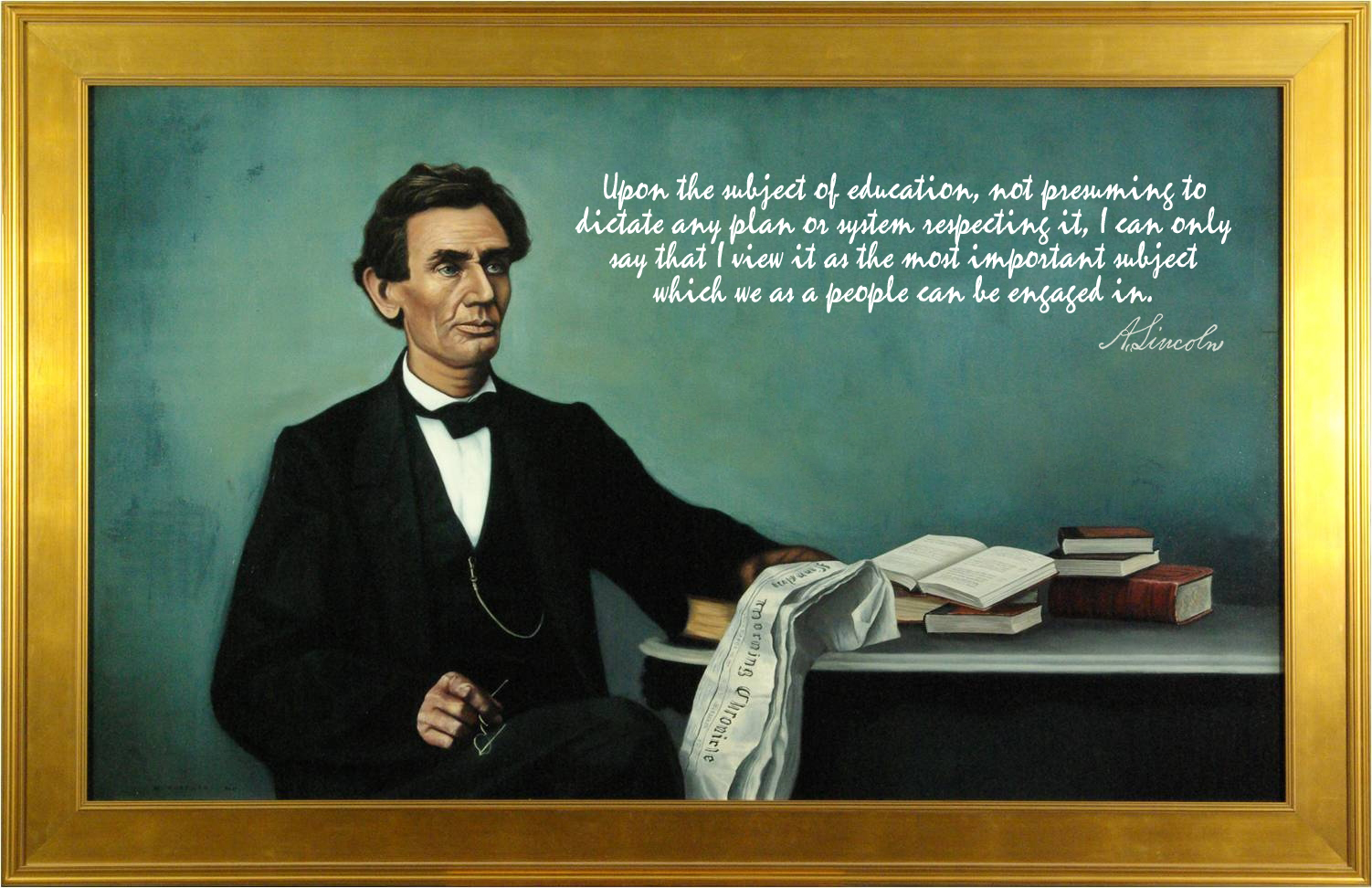
1860 Portrait of Abraham Lincoln by Leopold Grozelier.
The appointment of Abraham Lincoln as Postmaster of New Salem, Illinois, on May 7, 1833, was his first recognition by the general public. The fact that his political faith was not in harmony with the administration then in power must have assured him that he had gained the goodwill of all his neighbors. Following his election as a captain in the Black Hawk War and the very complimentary vote he received as a candidate for the legislature, this honor proved that he had the faculty of making friends. This was a fundamental qualification if one were to succeed in pioneer politics.

While the appointment as Postmaster did not come to Lincoln as a political favor for contributing to the party's success, then directing the affairs of the government, the position did afford him some exceptional opportunities for paving the way toward his own political success. He learned the entire population of that part of old Sangamon County, which later became Menard County. He was usually the first to make the acquaintance of new settlers who sought out the post office, that one point of general contact and information known in pioneer days.

The privilege of reading the newspapers and periodicals that came to the post office was of greater value than the purely local associations. It gave him a more comprehensive reading than most citizens in the county and allowed him to keep advised on all sides of any public question. I recently discovered in the Morgan County courthouse at Jacksonville, Illinois, the record book of the Postmaster at that place, which gives us a better knowledge than we had had before of the many journals in circulation in the state when Lincoln was Postmaster at New Salem. This old record book gives the titles of the papers and magazines and the names of the subscribers who received the publications between October 1831 and December 1832. Lincoln might be called a contemporary of the Jacksonville postmaster. His term of office began five months after the filing of these records. On the back cover of the old book is this citation: "Samuel Hill for two letters 37½¢." Hill was the Postmaster whom Lincoln succeeded at New Salem. As Jacksonville and New Salem were not more than thirty-five miles apart, it is reasonable to conclude that most of the publications which went through one post office were circulated through the other.

Mail arrived at the New Salem Post Office once a week, delivered on a route that ran from Springfield, IL, to Millers Ferry, IL. If addressees didn't collect their mail at the Post Office, which was customary, Lincoln delivered it personally — usually carrying the mail in his hat.

Lincoln received compensation of $55.70 ($1,931 today) in the fiscal year 1835. Besides his pay, Lincoln could send and receive personal letters free and get one daily newspaper delivered for free. Lincoln served as Postmaster until the office closed in May 1836.

About $18 ($590 today) was left in the New Salem Post Office's coffers when it closed in 1836, so Lincoln held onto the money. When a government agent later visited Lincoln to collect the funds, the future President, who was financially strapped then, retrieved the money from a trunk and presented it to the agent.

EARLY PUBLICATIONS
The following publications were delivered by the Postmaster of Jacksonville, Illinois, to subscribers residing in Morgan County, Illinois, between October 1, 1881, and December 31, 1832. The names of the subscribers and the amounts of postage they paid are listed with the title of the publication in a book in the archives of the Morgan County courthouse:

Alarm, Beardstown Chronicle, Bibical Repository, Boston Recorder, Casket, Christian Advocate, Christian Messenger, Christian Watchman, Cincinnati American, Evangelist, Farmers Chronicle, Focus, Gospel Herald, Home Messenger, Illinois Herald, Home Missionary, Journal of Commerce, Kankawn Banner, Kentucky Gazette, Kentucky Reporter, Ladies Book, Lexington Observer, Liberal Advocate, Louisville Focus, Louisville Post Advertiser, Marietta Gazette, Millenial Harbinger, Missionary Reporter, Missionary Herald, Missouri Republican, National Intelligencer, National Preacher, New York Observer, New York Optic, New York Post, New York Spectator, Niles Register, Ohio Patriot, Old Countryman, Palmyra Central, Philadelphia Evening Post, Plough Boy, Presbyterian, Revivalist, Sangamon Journal, Southern Advocate, Spirit Pilgrims, Standard, St. Louis Republican, St. Louis Times, Sunday School Banner, Sunday School Journal, Susquehana Democrat, Tennessee Herald, Theology, Vandalia Whig, Wayne Sentinel, Western Luminary, Western Pioneer, Youth's Friend. 

Compiled by Dr. Neil Gale, Ph.D.

Saturday, July 22, 2023

Schiller Woods Forest Preserve Magic Water Pump on Irving Park Road, Particulars.

The pump is located in Schiller Woods Forest Preserve in Schiller Park, Illinois, a suburb of Chicago. Google Maps: 41°57'08.8"N 87°50'38.6"W 

It was installed in 1945 to serve picnickers, just another of the hundreds of water pumps erected in the forest preserves of Cook County. 

It is a hand-operated pump that draws water from an aquifer. Many local residents believe the water has magical properties, improving health and vigor. Some believe the pump's water extends the life of anyone who drinks from it regularly, leading to the nickname "Chicago's fountain of youth." The pump is the most used of over 300 pumps maintained by the Forest Preserve Department of Cook County, necessitating yearly repairs. The pump handle was briefly removed in 1974 due to impurities but restored in 1975 after the water cleared.

There is no scientific evidence to support the claims that the water from the pump has any magical properties. However, many people swear by the water, and the pump remains a popular destination for people seeking a healthier lifestyle.

People say it has a specific taste and is unlike other waters. And it's not. It's the best water in the world! You've heard it's magic, right? I don't know if it is or if it has the rejuvenating qualities they say. But I don't try other pumps. 

It has been said that the Pope blessed it. "Holy water — that's what they call it." In 1979, Pope John Paul II visited the Northwest Side of Chicago. The Pope's motorcade drove along Nagle and Milwaukee avenues and the Kennedy Expressway and barely slowed down.

Those who swear by the Chicago's fountain of youth pump have said a lot of things: You hear it tastes better than tap water; it keeps colder for longer; it contains holistic qualities; it's good for heart and teeth; it's unfiltered and therefore not chlorinated or fluoridated; the water from this pump will keep you young an unnaturally long time.

There is no scientific evidence to support the claims that the water from this pump has magical properties.

The pump is located at the intersection of Irving Park Road and Cumberland Avenue. It is open from dawn to dusk. There is no fee to use the pump. If you're interested in visiting the pump, it's recommended that you go during the week. Remember to bring your own bottles to fill with water.

Compiled by Dr. Neil Gale, Ph.D.

Abraham Lincoln's Plank on Education

When Lincoln prepared his first circular to be distributed among the voters of Sangamon County, Illinois, in the summer of 1832, he worked a plank[1] on education into his political platform. The following excerpt shows his interest in the subject when he was only twenty-three. 
Upon the subject of education, not presuming to dictate any plan or system respecting it, I can only say that I view it as the most important subject which we as a people can be engaged in.


"Upon the subject of education, not presuming to dictate any plan or sys· tern respecting it, I can only say that I view it as the most important subject which we as a people can be engaged in. That every man may receive at least a moderate education, and thereby be enabled to read the histories of his own and other countries, by which he may duly appreciate the value of our free institutions, appears to be an object of vital importance, even on this account only, to say nothing of the advantages and satisfaction to be derived from all being able to read the Scriptures and other works both of a religious and moral nature, for themselves. 

For my part, I desire to see the time when education─and by this, morality, sobriety, enterprise, and industry─shall become much more general than at present, and I should be gratified to have it in my power to contribute something to the advancement of any measure which might have a tendency to accelerate that happy period." 

Compiled by Dr. Neil Gale, Ph.D.


[1] Lincoln's plank on education was a platform for the Republican Party in the 1860 presidential election. The plank called for universal education, meaning that all children, regardless of social class or race, should be able to attend school. The plank also called for establishing public schools, which would be funded by the government. Lincoln's plank on education was a radical idea at the time, as most children in the United States did not attend school. However, Lincoln believed education was essential for a democracy to function correctly. He argued that an educated citizenry would be better equipped to make informed decisions about government and to participate in civic life. The Republican Party's victory in the 1860 election helped to pave the way for establishing universal education in the United States. In the years following the Civil War, many states passed laws that established public schools and required children to attend school. Today, education is considered a fundamental right in the United States, and all children can attend school.

Friday, July 21, 2023

Cut-Rate Toys at 2424 West Devon Avenue, Chicago, Illinois, (1958-1991). My Story.

Marvin Hecht (1927-2019) opened Cut-Rate Toys at 2424 West Devon Avenue, Chicago, in 1958. He was an angry man who apparently didn't like children (his angry actions spoke volumes). He sat in his raised watch tower by the cashiers. 

I'm sure shoppers threw stuff at Hecht, which is why he wrapped his cage in chicken wire. Try yelling at adults to their faces and see what happens. Now I understand why he secured his little perch. Adults put up with Hecht's antics because the prices were low.

Hecht's philosophy regarding toys was "low price, high volume." He'd buy up odd lots at toy shows and pick up closeouts from Mattel, Milton Bradley, Hasbro and other toy makers. 
Marvin and Renee Hecht


“He would get on the microphones and say, ‘Get your children’s hands off the toys or get them out of the store, NOW!" his Daughter, Linda Karmin, said. “I mean, people were terrified of him.” Dad was a passionate musician who played classical piano concerts for charity.

Hecht habitually posted hand-written signs on the front door, naming and shaming children who had been caught stealing. The signs were quite blunt and always included the kid's name, address and telephone number of the shoplifter's parents.
You can see a note on the front door in this photo. Example: "Bobby Smith at 6512 North Washtenaw was caught stealing from this store. Call his parents at HO 5-0000 and ask them why they raised a child who steals." 


When I was there with my mom, I heard the owner yell at adults and kids over the loudspeaker. 

I went into Cut-Rate Toys by myself with the money I was gifted for my 10th birthday.  

I was looking to buy a Hot Wheels track set. I picked up a box to see all the sides and what was included. Suddenly, I heard the owner yell over the loudspeaker, "YOU... IN ISLE NUMBER FIVE, PUT THAT BOX DOWN NOW!!! DON'T TOUCH ANYTHING!" I was startled and embarrassed, and the box slipped out of my hands, hitting the floor and denting a corner of the box.

The owner came running out of his office, screaming, "NOW YOU'RE GOING TO BUY THAT!" I was furious. "If I'm not good enough to look at what I want to buy first," I said, "I just won't buy anything!" He grabbed me, but I was too quick and ran out of the store.

sidebar
At eight years old, I was taking the 155 Devon Bus to the Loyola 'L' station to take the subway downtown, by myself. I'd shop at Marshall Field & Company and usually went to Baer's Treasure Chest to play pinball and Skee-Ball and check out the Pro Magic Center on their second floor before heading home. In later years, I was lucky enought to meet Magician Marshall Brodien who worked part time at the Treasure Chest demonstrating complicated magic tricks for professionals. Brodien later opened the Magic Shop in Old Chicago shopping mall and amusement park in Bolingbrook, Illinois.

That was the last time I went to Cut-Rate Toys. I was so disgusted by the owner's behavior that I vowed never to give him my business again.

This behavior from a business owner would not be allowed today, as it would be considered harassment or defamation of a minor and perhaps result in a lawsuit.

In 1992, the store moved to 5409 West Devon Avenue in the Edgebrook neighborhood of the Forest Glen community in Chicago. The store closed in 2015. Marvin Hecht worked for 60 years in the toy business.

Copyright © 2023, Dr. Neil Gale, Ph.D.