Saturday, August 26, 2023

1858, July 30th, Destructive Fire on Van Buren Street, Chicago. $15,000 Loss!

Shortly after nine o'clock in the morning, a fire was discovered by Officer Wood, on his beat, in the rear of a large three-story frame structure on Van Buren Street near Clark Street, in the South Division, known as the Phœnix House and occupied for hotel purposes. The policeman instantly gave the alarm and burst into the front door of the house, the inmates of which were then, for the first time, apprised of their peril. When discovered, the fire was well at work on the east side of a low extension or shed used as a summer kitchen or washhouse and near the chimney. The Phœnix House was pretty well cleared of its contents, and the occupants all got out safely, though some of them with little reference to the appropriate apparel for street appearance.
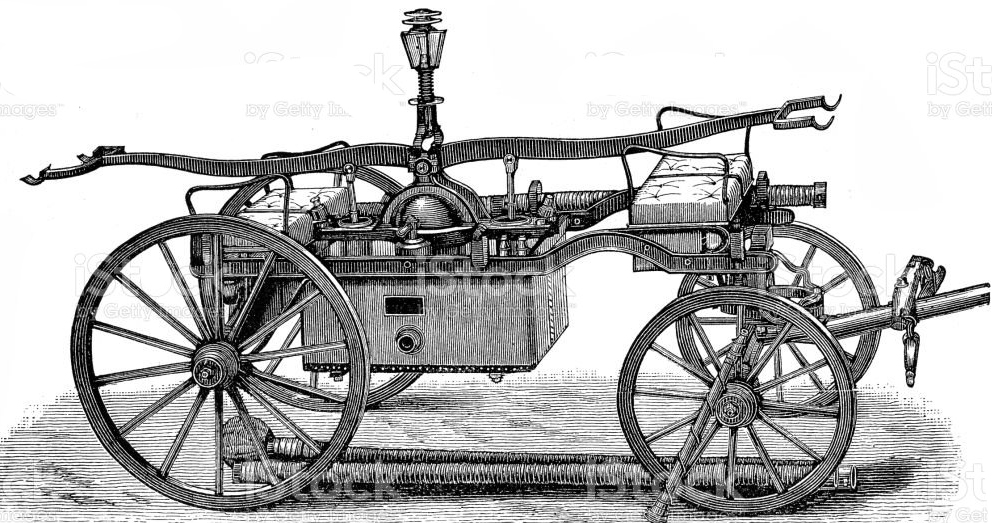
The № 1, Long John Steamer, was put into service in Chicago in 1858. It was the first steam fire engine in the city, and it helped to revolutionize the way that fires were fought. It was a 40-foot long, 14-foot high, and 8-foot wide vehicle. It weighed 10 tons and was powered by a 100-horsepower steam engine. The Long John could pump 500 gallons of water per minute.


The buildings in the vicinity of the fire were all made of wood and closely contiguous, and but that the surfaces of the same had been drenched by the recent showers, the disaster, under a little more wind that then prevailed, must have been wise-spread. As it was, before the conflagration could be stayed, it had extended to the various buildings surrounding the rear area of and adjoining the Phœnix House, including a four-story frame, an adjoining shop in which liquor was stored, the Exchange House (a two-story building), the Lafee House (a three-story building), № 126 to 134, inclusive, on Van Buren Street, a small unoccupied building and the Jennings House on Griswold Street—all of them frame structures, the Jennings House being a large and comparatively new building, standing vacant.

The fire department, including the smaller steam Fire Engine the "Enterprise" [1], was very promptly on the spot and as promptly at work with excellent streams, and did good service in holding the fire in check and finally subduing it. The Jennings House was badly damaged by fire and water. The Phœnix House and the Lafee House were about one-fourth consumed but will probably both be repaired. The smaller buildings were destroyed.

The list of owners and their losses were as follows:
The Phœnix House № 126, occupied by Patrick McConnell. Loss of $1,200 covered by Chicago Mutual.  Mr. McConnell had $1,000 worth of Brandy in an unoccupied barber's shop adjoining the hotel which was destroyed and not covered by insurance.

The Exchange House, № 130-132, is occupied by John Maloney. Loss of $1,200, insured for $800 in Chicago Mutual.

Lafee House, № 134, occupied by Jacob Lafee. Loss of $1,500, insured for $900.

All three of the above houses were owned by Jacob Gillan and valued at $5,600. Insurance officers took an inventory of the property and a policy for $3,000 to go into effect the day after the fire.

The Jennings House on Griswold Street was owned by Ballard & Wilcox. The building was worth about $6,000, with damage of $3,500, insured for $4,000 at the Merchants of Philadelphia and Phœnix of Hartford, Conn. It was unoccupied, but Martin Dodge, formerly of the Sherman House, would take possession in a few days.

The origin of the fire is unknown. The location in which the flames were discovered points to the chimney as the source of the disaster; the main reason for suggesting a different origin seems to be the fact that the premises in that vicinity have been fired three times in scarcely that many weeks.

Compiled by Dr. Neil Gale, Ph.D.


[1] The 1858 Steam Fire Engine "Enterprise" was a landmark invention that revolutionized firefighting. It was the first steam-powered fire engine in the United States, and it was much more powerful and efficient than the horse-drawn fire engines that were previously in use.

The Enterprise was built by the Seth Sweet Manufacturing Company of New York City. It had a boiler that produced steam that powered a piston that drove the pump. The pump could deliver up to 500 gallons of water per minute, which was much more than the 50-100 gallons per minute that a horse-drawn fire engine could deliver.

The Enterprise was also much faster than a horse-drawn fire engine. It could travel up to 10 miles per hour, which allowed it to get to fires more quickly.

The Enterprise was a huge success. It was used by fire departments all over the United States, and it helped to save countless lives and property from fire. It is considered to be one of the most important inventions in the history of firefighting.

Here are some additional facts about the 1858 steam fire engine Enterprise:
  • It was 25 feet long, 9 feet wide, and 10 feet tall.
  • It weighed 10 tons.
  • It had a crew of 12 firefighters.
  • It was powered by a 100-horsepower steam engine.
  • It could pump up to 500 gallons of water per minute.
  • It could travel up to 10 miles per hour.
  • It was first used by the New York City Fire Department in 1858, Chicago also received an Enterprise truck in 1858.
  • It was retired from service in 1884.
The Enterprise was a truly revolutionary invention that changed the way firefighting was done. It was faster, more powerful, and more efficient than any fire engine that had come before it, and it helped to save countless lives and property from fire. It is a testament to the ingenuity and creativity of the people who designed and built it, and it is a reminder of the important role that technology can play in protecting people and property from harm.

1858, August 20th, Disastrous Fire on South Clark Street, Chicago. $25,000 Loss!

The № 1, Long John Steamer, was put into service in Chicago in 1858. It was the first steam fire engine in the city, and it helped to revolutionize the way that fires were fought. It was a 40-foot long, 14-foot high, and 8-foot wide vehicle. It weighed 10 tons and was powered by a 100-horsepower steam engine. The Long John could pump 500 gallons of water per minute.


At about 3½ o'clock Saturday morning, a fire broke out in the rear part of a wooden structure № 244 South Clark Street, occupied as a bakery establishment by Louis Grossman. The flames spread rapidly in all directions, the wooden building being closely adjoining on all sides, and the conflagration only stayed after extending northward to the corner of Van Buren Street and south to the alley.

The following buildings were consumed: South of the bakery, Johnson's saloon and Rees' paint shop, ad north, Bonn's saloon and the long wooden block extending to van Buren Street.

The losses, as near as we can ascertain them, are as follows: № 298. paint shop of James C Rees, loss $200; no insurance. The building was owned by Osborn & Newhall, and was worth about $1,500. It was insured.

№ 296, a small saloon occupied by G. Johnson, loss $300. The building was owned by a widow lady living on the West Side, and was worth, probably, about $500.

№ 294, Louis Grossman's bakery and a stable in the rear. Loss $800; insured for $500. The building wqas owned by J.Busch, and was values at $1,500; insured for $800.

№ 292, a two-story building, occupied below by A. Bonn as a lager b eer saloon, and above by his family. Bonn's loss is about $300. The building was owned by Michael M. Gellan, and valued at $1,500; insured for $800 by the Merchant's insurance company.

The next building was the long block, № 282 to 290 inclusive, extending to Van Buren Street. It was owned by Boone & Larmon, and valued at $10,000, with an insurance of $7,000. The upper floor was occupied entirely by families, the lower part as follows: № 282, Mrs Pinkerton's millinery establichment. The stock was all saved. № 284 and 286, vacant. № 288, Beishoff's furniture store; stock mostly removed. № 290, A. Alexander's ice cream saloon, loss of $500; insured for $300 at Merchant's Insurance i Philadelphia. № 290½, P. Power's seconf hand clothing and furniture store, loss $500; No Insurance.

Compiled by Dr. Neil Gale, Ph.D.

Chicago's First Crime King, Irishman Michael Cassius McDonald. (1839-1907)

Though long-forgotten by many, latecomers like Capone, Torrio and Colosimo owe a debt of gratitude to Michael Cassius McDonald, the man who brought together criminals and elected officials, setting the stage for organized crime in Chicago. During a 50-year career in the underworld, journalists, gangsters, mayors, and even one President of the United States took orders from Chicago's original crime boss.

Michael Cassius McDonald arrived in Chicago just before the Civil War. A teenage runaway from Niagra Falls, New York, McDonald knew no one in Chicago. His childhood friend and fellow freight train jumper, Henry Marvin, died en route and was buried by McDonald without fanfare.
Michael Cassius McDonald


In the 1850s, Chicago became the nation's railroad hub, opening the city to a flood of eager young men with big ideas. For years, young men like Marshall Field, who opened a retail emporium in downtown Chicago, and George Pullman, creator of the eponymous sleeping and dining cars that made travel by train comfortable, later carried President Abraham Lincoln's body on a final journey from the White House to Springfield, Illinois, and Aaron Montgomery Ward, the founder of retail catalog sales, and an advocate for keeping Chicago's lakefront "open, clear and free" forever.

But when Mike McDonald rode the rails in the 1850s, passengers sat on hard wooden benches as they stared at an unchanging landscape through sooty windows.  With little to occupy bored passengers after consuming lunches brought from home, passengers eagerly welcomed the sight of boys called "candy butchers" who trudged through the aisles.  In exchange for a few pennies and free transportation to Chicago, runaways and orphans clad in ragged clothing peddled goods for the railroad. Sympathetic passengers, mistakenly believing that the boys received their fair share of profits, bought poor-quality goods from the candy butchers.  And Michael Cassius McDonald was the most successful candy butcher of his time.

An Enterprising Lad
Slight in stature, he peddled books and fruit to kind-hearted ladies. Male passengers, duped by his innocent appearance, took candy home only to discover when opened by a loved one, the boxes were half empty. Eager to increase his profits, McDonald expanded his business to include phony raffle tickets. Chicago crime writer Richard C. Lindberg credits McDonald with inventing the "prize package swindle." Lindberg explains that McDonald guaranteed a cash prize of up to $5 in every box of candy purchased. Most prizes amounted to a few cents, but once hooked by the possibility of a big prize, greedy passengers tried and tried again, leading McDonald to proclaim, "There is a sucker born every minute" long before film star W.C. Field uttered the famous phrase.

Most boys were tired of the grind, working long days for pennies and sleeping in dirty railroad yards a  night. But, now in his late teens, McDonald wasn't like most boys. He expanded his business. He learned to play cards from wealthy passengers, not afraid to gamble tidy sums of money. A keen observer of human behavior, McDonald watched their body language as they bluffed and wagered through intense poker games. S on, he exchanged his ragged clothes for the attire of a card sharp: a crisp suit, polished shoes and an ever-present cigar.  e continued to work days, but at night, he joined floating card games in The Sands, Chicago's vice district, going up against some of the best card sharps in the country.

Until the election of Mayor John Wentworth in 1857, Chicago officials unofficially tolerated The Sands, but within a few weeks of his first term, Mayor Wentworth declared war on The Sands. Literally, overnight, the mayor and his police force destroyed The Sands, burning to the ground or tearing down every shack, brothel and gambling parlor after issuing a 30-minute warning to occupants to get out.

But Mike McDonald was not discouraged. He correctly predicted that gambling, no longer contained in one Chicago neighborhood, would spread throughout the city, making finding gamblers harder for police. In fact, the police force was so inept that Mayor Wentworth fired the entire department until public pressure forced him to reverse his decision.

Discrimination against the Irish and Irish Americans prohibited McDonald from applying for many honest jobs; elected officials enacted legislation banning immigrants from holding city jobs. But McDonald's il gal business was flush with a customer base, including politicians, judges and city officials.

Gaming the System
McDonald operated Chicago's most successful floating faro game, a European card game popularized in America by Wyatt Earp and Mississippi Riverboat gamblers. Played with a unique deck of cards laid out on an elaborately decorated card table with hidden compartments to allow dealers to skim money, players had little chance of winning. Occasionally McDonald instructed his dealers to adjust the game in favor of influential business leaders but quipped, "Never give a sucker an even break" – another phrase later popularized by W. C. Fields. Games often ended in violence, but by this time, local cops could be called upon to remove the angry patron in exchange for a bonus from McDonald's men.

When President Abraham Lincoln called upon Illinois citizens to sign up for duty in the Union Army, McDonald did his best to aid the call to action. Though able-bodied, 22-year-old Mike McDonald did not enlist in The Irish Brigade. Instead, he organized groups of bounty jumpers. These men collected a $300 signing bonus called a bounty and then deserted the army as soon as possible with money in hand and returned to Chicago to enlist under an assumed name. McDonald pocketed 50% in exchange for a promise of immunity from a crime punishable by hanging. Government officials desperate to fill quotas looked the other way as McDonald signed up Chicago's drunken, derelict and destitute men. During the first two years of the Civil War, Illinois supplied more than 130,000 men to the Union army. McDonald's accumulated enough money to purchase a saloon and adjoining gambling parlor in a luxury Chicago hotel.

Perhaps it was ready access to an unlimited supply of alcohol that fueled McDonald's violent temper. On one occasion, he punched and kicked a 60-year-old woman who owned a roadhouse he frequented; he knocked down a man who tried to steal his handkerchief; he pummeled a man in a saloon, and when the poor fellow tried to defend himself against McDonald, the police hauled the man off to jail.

Chicago and Mike McDonald prospered as the nation suffered through the Civil War. Businessmen in tow to negotiate lucrative Union contracts, White southerners displaced by war and Confederate soldiers, and escapees from a prison camp on Chicago's south side provided a steady stream of gamblers at McDonald's gambling hall. Through his wealthy customers, McDonald learned of skyrocketing land values caused by the demand for new factories and housing for workers, and he invested heavily in real estate. By the war's end, McDonald owned several buildings, four gambling clubs and a liquor distributorship.

His notoriety attracted women of a specific type: young and flashy. Isabella or Belle Jewel met Michael McDonald when she danced in the chorus line at a popular theater where John Wilkes Booth performed Shakespeare. Smitten by Bell's beauty, McDonald quickly welcomed her into his circle of friends, introducing her as Mrs. McDonald, though they never married. They dined in the finest restaurants and lived in an exclusive neighborhood. Whether it was physical abuse at McDonald's hand or his habitual drunkenness that drove Belle to leave him after seven years, she did so with a flair for the unexpected. The former chorus girl, no longer the belle of the ball, joined a St. Louis convent, where she remained until she died in 1889.

Michael Cassius McDonald served jail time in 1869. He was arrested for allegedly stealing $30,000 from an assistant cashier of the Chicago Dock Company. The cashier had given the money to McDonald to finance his gambling operations. McDonald was unable to afford bail, and, consequentially, spent three months in prison prior to being acquitted at his trial. He never served prison time again.

The Great Chicago Fire
A few weeks after Belle's sudden departure from Chicago, the Great Chicago Fire of 1871 destroyed most of Chicago and every personal possession, business and building McDonald owned. Chicago and Michael Cassius McDonald were ruined, but not for long.

Chicago began rebuilding almost immediately after the outgoing mayor honored hundreds of dead citizens by closing saloons for one week.

By the end of the year, McDonald married Mary Ann Noonan Goudy, a stunning 24-year-old divorcee and mother of two. She and her toddlers moved into the house McDonald had shared with Belle Jewel.

Thousands of laborers rushed to Chicago to build new houses for over 90,000 homeless citizens (Chicago Shelter Cottage Kits Built Immediately After the Fire). For months, skilled tradesmen arrived at a busy railway station in the heart of a red-light district where McDonald set up a shabby but conveniently located ga bling parlor. To outsmart competing gambling parlors in the area, McDonald hired well-dressed men to greet passengers as soon as they arrived. Yes, McDonald's men knew where to get a hot meal and, incidentally, an "honest" card game to pass the time while looking for employment.

McDonald's business drew the attention of Chicago's new mayor, Joseph Medill, co-owner of the Chicago Tribune; Mayor Medill tried to shut him down. Medill successfully lobbied the state legislature to increase penalties for owners of gambling parlors. He forced saloon owners to close on Sunday, the one day a week that laborers were free to enjoy a drink or two at their neighborhood tavern. He ordered his police superintendent to raid gambling parlors. When he was lax in carrying out his duties, Medill's newspaper published a list of known gambling parlors and their locations.

With the support of the liquor distributors association and the publisher of a competing newspaper, McDonald publicly opposed the mayor's edict to close saloons on Sunday. For a while, saloons remained open, but owners dimmed the lights, locked the front door and admitted patrons through a side or back door.

Well aware that the police superintendent knew his men took bribes from gambling parlors, including his own, McDonald threatened to expose him. As a compromise, McDonald and others under his protection received advance notice of impending raids. For the benefit of the public, police officers removed gambling equipment they stored for pickup by the owners the following day. On occasion, the police smashed furniture, but only well-worn or broken items chosen by the owner. McDonald posted bail if an employee or gambler was inexplicably arrested in the raids.

Mayor Medill continued to pressure McDonald's, but the gambling king emerged victorious. The police superintendent and his successor were fired. Mayor Medill fled to Europe to seek treatment for unnamed health issues. McDonald successfully fully offered his own candidate to replace Mayor Medill. With a new mayor in office, McDonald flourished. Upon McDonald's request, Mayor Harvey Colvin repealed the law that banned the sale of alcohol on Sundays. Recognizing McDonald's ability to get things done, Chicago's gambling community clambered for McDonald's support – the result, Chicago's original crime syndicate. Flush with payoffs from politicians who paid McDonald hush money in connection with their own shady businesses and funds contributed by small and big-time gamblers, McDonald opened the most notorious gambling house in America.

The Store
In September 1873, the beautifully crafted wooden doors of McDonald's 24/7 department store of gambling, popularly known as "The Store," swung open to reveal the luxurious interior of a multi-story brick building: fine carpets, thick velvet drapes and gleaming mirrors. A cigar store that sold the finest imported cigars and a saloon stocked with the best wines available occupied the ground level. On the second floor, a staff of impeccably dressed men stood behind oak gambling tables, ready to greet well-heeled players. The Palace European Hotel, little more than a fancy rooming house, welcomed out-of-town gamblers on the third floor. No longer happy to occupy the home of her husband's former lover, Mary and the kids lived together on the upper floor with McDonald as an occasional overnight guest.

McDonald extended credit to politicians who walked over from City Hall and U.S. Senator James G. Fair. A frequent visitor from Nevada, Fair made millions from co-ownership of the Comstock Lode, the richest silver mine in the United States, and from a partnership in a California railroad, Fair couldn’t resist paying a visit to The Store when he changed trains in Chicago on his way to work in Washington, D.C. Sir Charles Russell, a member of the British Parliament, played poker at The Store. McDonald treated with generosity wives who complained their husbands gambled away the family rent money, refunding their losses and vowing to ban them from The Store. He contributed to charities. When someone asked McDonald for a contribution of $2 to help defray the cost of burying a fallen police officer, he quipped, “Here’s $10, bury five of them.”

Despite McDonald’s dislike of policemen, he kept some on his payroll. He brandished a pistol at a large political gathering, but officers on duty kept their distance. Police escorted drunken voters to a polling place set up at McDonald’s business, where he offered naturalization papers and voter registration forms on the spot. During a drunken rage, he broke the nose of a stranger who commented on a newspaper article unfavorable to McDonald and his supporters. The man filed criminal charges, but the case never reached the court. McDonald assaulted a newspaperman and threatened to cut off his ear. When arrested for the attempted murder of a rival gambler, a police officer escorted him to jail in a special carriage and recommended to the judge McDonald be released on bail immediately. Of course, he was acquitted of all charges, and that evening, he held a banquet for judges, city officials and police officers.

For a time, members of the Chicago police force disregarded department orders to raid The Store. But occasionally, policemen showed up unannounced. One evening, a group of officers bounded into The Store and up the stairs to the family living quarters with a warrant to arrest McDonald. Mr. McDonald was not home then, but Mrs. McDonald was. She responded by firing two shots at the policemen. Charged with attempted murder, she was led to a penitentiary where she stayed just until her husband hired an expensive lawyer named Alfred Trude and bribed a judge who released Mary before reprimanding the policemen for their unlawful raid of the McDonald family home.

Like her husband, Mary enjoyed keeping company with minor celebrities who performed in Chicago’s many theaters. She quickly fell in love with Billy Arlington, an African-American banjo player who lived with his wife Julia on Chicago’s South Side. Mary showered Arlington with gifts and even brazenly introduced him to her husband at a dinner party. When Billy had to leave Chicago for a performance in San Francisco, Mrs. McDonald followed. By the time they reached Denver, Mary declared her undying love for Billy Arlington in a letter she mailed home to her husband. Undeterred, McDonald followed the couple to San Francisco, where he threatened Billy and Mrs. McDonald with a loaded pistol.

McDonald forgave his wife for her indiscretion. He promised his wife a new home away from The Store and sealed the deal when he moved his family to a limestone mansion on a wide boulevard lined with houses of prominent Chicagoans, including the mayor.

Mary promised to be faithful, and for a while, she was. Through her husband's generous contributions to a local Catholic Church, she met Father Joseph Moysant. While church workers completed the preparation of his living quarters at the church, Mary offered the priest a spare room, and often her own room, in the McDonald's spacious mansion. On one occasion, they took a secret trip out of town. They continued a clandestine affair undetected for two years until they decided to leave Chicago forever.

Like Belle Jewel, Mary left Chicago wearing a nun's habit, but she had no intention of joining a convent. The lovers took a train to New York, where they boarded a ship bound for Paris. This time, it took McDonald two months to track her down. Under the advice of his lawyer, Alfred Trude, the man who defended Mrs. McDonald against the attempted murder of a policeman, McDonald filed for a divorce. Shak n by his wife's latest infidelity, he lamented to a friend, "When you cannot trust your wife and your priest, whom can you trust?"

Though busy operating his gambling parlor, collecting protection money and distributing police bribes, McDonald ran some honest and not-quite-honest enterprises. He bought the Chicago Globe newspaper, rivaling former Mayor Medill’s newspaper, the Chicago Tribune. He commanded hustlers and pickpockets to stay clear of the area around the Columbian Exposition so as not to damage Chicago’s reputation while it hosted millions of fairgoers. At a private meeting in the White House, he persuaded President Chester Arthur to pardon a colleague convicted in a Ponzi scheme. 

He operated a racetrack. He invested in a quarry that sold limestone to city contractors at inflated prices. He hired a crew to paint city hall with a special liquid guaranteed to render the crumbling building waterproof and fireproof, billing the City of Chicago $180,000 for a job estimated at $30,000. The unique liquid turned out to be a worthless mixture of lime, lead and linseed oil.


He built the West Side Lake Street 'L' that connected the Loop, which began service on November 6, 1893. Regular passenger service began between Madison Street and Market Street to California Avenue. Over 50,000 passengers rode on the first day. The line was extended west to Homan Avenue on November 24, 1893, to Hamlin Avenue in January 1894, to 48th Avenue (now Cicero Avenue) in March 1894, and to 52nd Avenue (now Laramie Avenue) in April 1894. When the completed Loop opened on October 3, 1897, the Lake Street Elevated became the first line to utilize the entire quadrangle. So shrewd was Michael McDonald that he bribed city aldermen thousands of dollars to buy their votes—ensuring that one of the train stops was near one of his illegal racetracks on the West Side.

McDonald was a busy man, but still, a man who loved women. At age 56, he married a 21-year-old Jewish actress named Dora Feldman, who he remembered from the times she and his son played together as schoolmates. Like McDonald, Dora was divorced, and like his former wife, the new Mrs. McDonald was attracted to artistic types. For a few years, the couple was happy to host lavish dinner parties in the home McDonald purchased for Dora and to dine late at night in fine restaurants after the theater or opera. But McDonald was getting older and slowing down. While he spent his afternoons napping, Dora sneaked away to meet her teenage lover, Webster Guerin. Guerin couldn’t support himself by selling his paintings, so Dora set him up in a picture-framing business downtown. Whether or not McDonald suspected his wife of carrying on a long-term affair, he continued to love his wife, even to the point of converting to Judaism and not questioning how she spent his money.

When Dora suspected that Webster Guerin was seeing another woman, who, in fact, was his brother’s girlfriend, she became enraged. She threatened to kill the woman. She threatened to kill Guerin. On a cold February morning, Dora burst into her lover’s office and shot him dead in full view of witnesses. Though she admitted to the police she killed her lover, she told her husband that she killed the man because she was blackmailing her. McDonald paid for her defense, a team of prominent lawyers led by Alfred Trude, who defended his first wife against a charge of attempted murder.

The scandal took a toll on McDonald, and he did not live to see his wife acquitted of murder. Michael Cassius McDonald died with his former wife, Mary, at his side, and McDonald had $2 million in assets ($65M today).

Michael Cassius McDonald was interred at Mount Olivet Catholic Cemetery on August 9, 1907, in Chicago, Illinois.

Compiled by Dr. Neil Gale, Ph.D.

Friday, August 25, 2023

The Laughing and Literary Lincoln.


Abraham Lincoln was the only President who was both a humorist and a literary artist. Lincoln's funny stories not only entertained people; they also helped him make important points. Lincoln was utterly without malice, but he was the most vilified of all our presidents. His sense of humor, however, as well as his deep devotion to democratic ideals, led him to respond to personal attacks with tolerance and magnanimity. And he enshrined his democratic faith in some of the most beautiful English prose ever written. 

Abraham Lincoln was the first humorist to occupy the White House. "He could make a cat laugh!" exclaimed Bill Green. "It was as a humorist that he towered above all other men it was ever my Jot to meet,'" said another friend from Lincoln's youth. H. C. Whitney, a lawyer who rode the circuit with Lincoln in Illinois, was struck by Lincoln's keen sense of the absurd: "He saw the ludicrous in an assemblage of fowls, in a man spading his garden, in a clothesline full of clothes, in a group of boys, in a lot of pigs rooting at a mill door, in a mother duck teaching her brood to swim-in everything and anything." During the Civil War, London's Saturday Review told its readers: "One advantage the Americans have is the possession of a President who is not only the First Magistrate, but the Chief Joker of the Land." By the middle of 1863, several joke books with titles like Old Abe's Jokes, Abe's Jokes, Fresh from Abraham's Bosom, and Old Abe's Jokes. or, Wit at the White House were circulating in the North and spreading Lincoln stories, many of them spurious, far and wide; and there have been collections of Lincoln anecdotes in print ever since.

Humor was unquestionably a psychological necessity for Lincoln, though, being a serious, not a solemn, man, he wouldn't have put it quite that way. He once called laughter "the joyous, beautiful, universal evergreen of life," and he enjoyed droll stories the way some people enjoy detective stories. But both as a lawyer and as a politician, he also found amusing stories enormously helpful in putting across important points he wanted to make. And as president he used his gift as a storyteller to put people at ease, to win them over to his point of view, or simply to get them off the point and out of his office without having to deny their requests in so many words. Humor, he once said, was "an emollient" that "saves me much friction and distress." A group of people who had gone to the White House seeking government jobs reported resignedly afterward that "the President treated us to four anecdotes." But humor was also important for Lincoln during the Civil War as a means of relaxing, getting away from his troubles for a moment, and refreshing his spirit. Once, when a congressman came to see him to complain about something, Lincoln said, "Well, that reminds me of a story." Outraged, the congressman told him he had not come to the White House to hear a joke. "Now, you sit down!" exclaimed Lincoln. "If I couldn't tell these stories, I would die." On another occasion, Ohio's Senator Benjamin Wade called to demand that General Grant, who was not doing very well before Vicksburg at the time, be fired at once. "Senator," said Lincoln, "that reminds me of a story." "Yes, yes," said Wade impatiently, "that is the way it is with you, Sir. all story, story! You are the father of every military blunder that has been made during the war. You are on the road to hell. Sir, with this government, by your obstinacy, and you are not a mile off this minute!" "Senator," said Lincoln gently, "that is just about the distance from here to the Capitol, is it not?"

Lincoln's taste in jokes ran all the way from the lowly pun to the satirical anecdote. Like all lovers of the English language, he took keen pleasure in plays upon words. Once he was looking out of the window of his law office in Springfield, Illinois. and saw a stately matron, wearing a many-plumed hat, picking her way gingerly across the muddy street. Suddenly she slipped and fell. "Reminds me of a duck," said Lincoln. "Why is that?" asked a friend. "Feathers on her head and down on her behind," said Lincoln. On another occasion, he was taking a walk in Washington with his secretary of state, William H. Seward, and they passed a store with the name of the proprietor, T. R. Strong, in bold letters on a sign in front of the store. "T. R. Strong." said Lincoln. "but coffee is stronger." Seward smiled but made no reply. "We don't see how he could reply after so atrocious a thing as that," commented the newspaper which reported the story.

But Lincoln's humor ordinarily rose above the level of puns. He particularly enjoyed teasing solemn people. When a temperance committee called to tell him that Union defeats were "the curse of the Lord" on a drunken army, Lincoln (who was a teetotaler) could not resist saying that it was "rather unfair on the part of the curse, as the other side drank more and worse whiskey than ours did." He treated some Chicago ministers who came to give him advice the same way. When they told him, they had come to deliver "a message to you from our Divine Master" about his slavery policy. Lincoln said it was "odd that the only channel he could send it by was the roundabout route of that awful wicked city of Chicago!" He had some fun, too, with a pompous Austrian count who wanted to obtain a position in the Union army. In making his request, the Austrian harped on the fact that his family was ancient and honorable and that he bore the title of count. With a twinkle in his eye, Lincoln finally patted him on the shoulder and said, "Never mind, you shall be treated with just as much consideration for all that. I will see to it that your bearing a title shan't hurt you." 

Lincoln's humor was not always gentle. Sometimes he used it to point up a blunt truth. Asked once how large the Confederate army was, he said, "About 1,200,000 men," and when his questioner expressed amazement, Lincoln explained: "Well, whenever one of our generals is licked, he says he was outnumbered three or four to one, and we have 400,000 men." He also could not help making wry remarks about General George B. McClellan, whose extreme caution in pushing military campaigns drove Lincoln almost crazy. Once, when a man from a Northern city asked him for a pass to Richmond, Lincoln exclaimed: "My dear sir, if I should give you one, it would do you no good. You may think it very strange, but there are a lot of fellows who either can't read or are prejudiced against every man who takes a pass from me. I have given McClellan and more than 200,000 others. passes to Richmond. and not one of them has gotten there!" A little later, greatly irked by McClellan's inactivity, he wrote: "Dear General, if you do not want to use the army, I would like to borrow it for a few days." Lincoln gave as good as he got, too. when he felt like it. When McClellan. irritated by one of Lincoln's orders requiring detailed reports to the White House, sent him a telegram saying, "We have just captured six cows. What shall we do with them?" Lincoln answered: "Milk them." 

Sometimes Lincoln's humor had satirical and ironic overtones. When he was in Congress. 1847-1849. he opposed the Mexican War, and in one speech, he said that people who denied that it was a war of aggression reminded him of the Illinois farmer who said, "I ain't greedy 'bout land. I only want what  belongs to me." "Young America," he said in another speech, "is very anxious to fight for the liberation of enslaved nations and colonies, provided, always, they have land. As to those who have no land and would be glad of help, he considers they can wait a few hundred years longer." He once told of a congressman who had opposed the War of 1g12 and come under heavy attack and who, when asked to oppose the Mexican War. exclaimed: "I opposed one war; that was enough for me. I am now perpetually in favor of war, pestilence, and famine." And he liked to tell people about the old loafer who said to him, "I feel patriotic," and when asked what he meant, cried, "Why, I feel like I want to kill somebody or steal something!" A Toledo reporter who interviewed Lincoln at the time of the Lincoln-Douglas debates decided he was "a master of satire, which was at times as blunt as a meat-ax, and at others as keen as a razor." Once, a senator came to the White House, furious about what he regarded as an unfair distribution of patronage, and he let loose a flood of profanity on Lincoln. When he had finished, Lincoln said calmly, "You are an Episcopalian, aren't you, Senator?" "Yes. sir, I belong to that church." "I thought so," said Lincoln. "You Episcopalians all swear alike. But Stanton [secretary of war] is a Presbyterian. You ought to hear him swear!" Lincoln. who rarely used intemperate language, was frequently criticized for not being a church member, and he was doubtless amused at hearing profanity from the Orthodox. 

Lincoln laughed at himself as well as at other people. When Senator Stephen A. Douglas called him a "two-faced man," Lincoln said: "I leave it to my audience. If I had another face, do you think I would wear this one?" He joked about his homely looks again when he spoke to a convention of newspaper editors in Bloomington, Illinois. Pointing out that he was not an editor and therefore felt out of place at the meeting, he said: "I feel like I once did when I met a woman riding on horseback in the woods. As I stopped to let her pass, she also stopped and looked at me intently and said. 'I do believe you are the ugliest man I ever saw.' Said I, 'Madam. you are probably right. but I can't help it."No,' said she, 'you can't help it, but you might stay at home.' "Lincoln also enjoyed telling about the grouchy old Democrat who walked up to him and said. "They say you're a self-made man," and when Lincoln nodded, he snapped, "Well, all I've got to say is that it was a damned bad job." 

Lincoln came to be known as "the National Joker." but he was far more than the Chief Joker of the land. As president he showed himself to be shrewd. serious. selfless. dedicated, strong-willed, resourceful, compassionate, and extraordinarily magnanimous. The burdens he bore during the Civil War were far heavier than those of most American presidents, and he undertook his responsibilities with remarkable patience and determination. Though his critics could not always see it. he remained steadfastly true throughout the war to his basic objectives: restoration of the Union (which he regarded as a magnificent experiment in government of. by. and for the people) and the abolition of slavery (which he regarded as utterly incompatible with democracy). He was anxious to get the very best men. civilian and military. he could find to help him in realizing these objectives, and he did not mind if they personally held him in contempt. When someone told him that his secretary of war. Edwin Stanton. had called him a damned fool. he said lightly. "If Stanton said I was a damned fool. then I must be one. for he is nearly always right and generally says what he means." Stanton came to hold Lincoln in high esteem. But others never did. They found it hard to understand that in pursuing his objectives of preserving the Union and emancipating the slaves- Lincoln had to proceed cautiously to avoid alienating the border slave states (and driving them to secession) and keep from offending Northern public opinion (which was by no means sympathetic to abolitionism at first). He also thought it important to synchronize his policies with progress on the battlefield (which came slowly at first) if he was to avoid making futile and perhaps even counterproductive gestures. 

No president of the United States has been vilified the way Lincoln was during the Civil War. He was attacked on all sides: by abolitionists, Negrophobes, state righters, strict constitutionalists, radicals, conservatives, armchair strategists, and by people who just did not like his looks or who resented his storytelling. From the day of his inauguration to the day of his assassination, the litany of invective was unrelenting. Among other things, Lincoln was called: an ape; a baboon; a buffoon; a low-level obscene clown; a usurper; a traitor; a tyrant; an old monster; the Great Apotheosis of the Great Hog; Fox Populi; a cross between a sand-hill crane and an Andalusian jackass; Abraham Africanus the First; a smutty joker; a third-rate country lawyer; an African gorilla; an abortion; an idiot; Simple Susan; the Abolition orangutan; the incompetent, ignorant, and desperate "Honest Abe"; a border-state eunuch; a narrow-minded bigot; an unprincipled demagogue; a driveling, idiotic, imbecilic creature; a third-rate district politician; a lunatic; a despot; a dangerous character; the ineffable despot; a blunderer; a charlatan; a temporizer; a man who jokes when the nation mourns; a crude, illiterate, bar-room willing; an unblushingly corrupt bully; and a half-witted usurper. One New York newspaper regularly referred to him as "that hideous baboon at the other end of the avenue". It said that "Barnum should buy and exhibit him as a zoological curiosity." The Illinois State Register called him "the craftiest and most dishonest politician that ever disgraced an office in America." "Honest Abe, forsooth!" sneered one editor. "Honest Iago! Benignant Nero! Faithful Iscariot!" Even his hometown newspaper joined the chorus: "How the greatest butchers of antiquity sink into insignificance when their crimes are contrasted with those of Abraham Lincoln!" No wonder Lincoln said, when asked how it felt to be president, "You have heard about the man tarred and feathered and ridden out of town on a rail? A man in the crowd asked how he liked it, and his reply was that if it wasn't for the honor of the thing, he would much rather walk." But Lincoln was not thinking of the abuse heaped on him when he said this. He was thinking of the terrible loss of life on the battlefield and the heartbreakingly slow progress being made toward the achievement of his objectives. He had enjoyed politics immensely before he became president and he had been eager, too, to hold the highest office in the land. But in the White House. he said, instead of glory, he found only "ashes and blood."

Humor lightened the cares of office for Lincoln. So did the theater. He had a special fondness for Shakespeare, and he experienced exquisite pleasure one evening at seeing the veteran actor, James Hackett, perform the role of Falstaff in a Washington theater. He was so delighted with the performance that he wrote a letter of congratulation afterward, and Hackett, flattered by the attention paid him by the president of the United States, turned the letter over to the New York Herald. For the Herald, Lincoln's letter provided another opportunity for ridicule, and the editor reprinted the letter and accompanied it with savage comments. Greatly embarrassed, Hackett wrote Lincoln to apologize. "Give yourself no uneasiness on the subject," Lincoln told him. "I certainly did not expect to see my note in print, yet I have not been much shocked by the comments upon it. They are a fair specimen of what has occurred to me throughout my life. I have endured a great deal of ridicule without much malice and have received a great deal of kindness. not quite free from ridicule. I am used to it." For Lincoln, the pleasure of seeing Hackett do Falstaff far outweighed the pain of abuse from the Herald. But even this pleasure was short-lived. A little later, Hackett sought a government job, and when Lincoln was unable to give him one, he turned against the president and joined the ranks of the Lincoln haters. 

Lincoln's Jove of Shakespeare grew out of his Jove of fine writing. As a young man, he read and reread the King James Bible, Ӕsop's Fables, Shakespeare, John Bunyan, Daniel Defoe, and Robert Burns, and he worked hard to improve his own vocabulary. grammar, and lucidity of expression. By the time he became president. he had developed a distinguished prose style of his own: simple, clear. precise. forceful. rhythmical. poetic, and at times majestic. When Vicksburg surrendered in July 1863, and the Mississippi River was open again, he told the country: "The'Father of Waters' again goes unvexed to the sea." It is hard to imagine any other president writing such a stunning sentence or penning such masterpieces of prose as the Gettysburg Address (which even H. L. Mencken called "genuinely stupendous") and the First and Second Inaugural Addresses. Thomas Jefferson and Woodrow Wilson (and, to a lesser degree, John Adams and Theodore Roosevelt) possessed unusual literary skills, but at his best, Lincoln towered above them. He had a deep feeling for the right use of words, and he employed them lovingly both in his story-telling and in his letters and speeches. He was the only president ever to be called a "literary artist." Jacques Barzun, in fact, called him a "literary genius." Jl "Nothing," wrote John Nicolay and John Hay, in their multi-volumed biography of Lincoln (whom they knew. personally) appearing in 1894, "would have more amazed him while he lived than to hear himself called a man of letters; but this age has produced few greater writers." Ralph Waldo Emerson ranked Lincoln with Ӕsop in his lighter moods. Still, when it came to serious moments, he said this of the Civil War President: "The weight and penetration of many passages in his letters, messages, and speeches, hidden now by the very closeness of their application to the moment, are destined to a wide fame. What pregnant definitions, what unerring common sense, what foresight, and on great occasions, what lofty, and more than national, what human tone! His brief speech at Gettysburg will not easily be surpassed by words on any recorded occasion."

At Gettysburg on November 19. 1864. Edward Everett, famed for his oratory, spoke for close to two hours, and Lincoln took up only a few minutes. Afterwards. Everett took Lincoln's hand and said: "My speech will soon be forgotten; yours never will be. How gladly would I exchange my hundred pages for your twenty lines!" 

By Paul F. Boller, Jr.
Edited by Dr. Neil Gale, Ph.D.

1858, July 7th, Fire on East Kinzie Street, Chicago.


At about 3 o'clock in the morning, a fire was discovered in the unoccupied two-story frame building, № 224 East Kinzie Street. The fire was extinguished after the building had been damaged to the extent of four or five hundred dollars. It is owned by Michael Lantry, and the loss is covered by an $800 insurance policy. 
The № 1, Long John Steamer, was put into service in Chicago in 1858. It was the first steam fire engine in the city, and it helped to revolutionize the way that fires were fought. It was a 40-foot long, 14-foot high, and 8-foot wide vehicle. It weighed 10 tons and was powered by a 100-horsepower steam engine. The Long John could pump 500 gallons of water per minute.


From the fact that combustibles, saturated with camphene, were found on the upper floor, and the building was fired in several places, there is no doubt the fire was the work of an incendiary. The scoundrels obtained an entrance by climbing through the second-story back window. The house adjoins the Parmalee Hotel on the east, a four-story brick structure, and on the west and rear are a number of wooden structures, and on the west and rear are a number of wooden buildings. It was a narrow escape from a widespread conflagration.

Compiled by Dr. Neil Gale, Ph.D.

Thursday, August 24, 2023

1858, July 2nd, Destructive Conflagration at Fulton and Jefferson Streets, Chicago.

At about half past six o'clock, Mr. P.B. Lamb's planning mill, corner of Fulton and Jefferson streets, caught fire, and in a few moments, the entire building was wrapped in flames.
The Number 1, Long John Steamer, was put into service in Chicago in 1858. It was the first steam fire engine in the city, and it helped to revolutionize the way that fires were fought. It was a 40-foot long, 14-foot high, and 8-foot wide vehicle. It weighed 10 tons and was powered by a 100-horsepower steam engine. The Long John could pump 500 gallons of water per minute.


Mr. Lamb's loss is $6,000, on which he had no insurance. In the lumber yard adjoining the mill, Mr. H.M. Lewis lost $1,500 worth of lumber, which he is covered by insurance for $1,300 by Home Insurance of New York. The Galena and Chicago Union Railroad also lost $60 worth of lumber, and Mr. Walter Lull lost $160 worth.

Adjoining the yard on the south were two two-story frame buildings, № 62 and № 60 Jefferson Street, owned by D.L. Jacobus & Co. and occupied by them as a furniture store and warehouse. Most of the furniture was saved, but the buildings were totally destroyed. A large quantity of hard lumber owned by this firm was burned. The large four-story brick furniture factory, № 56 Jefferson Street, owned and occupied by Jacobus & Co., was on fire a number of times and was considerably damaged by fire and water, as is also the machinery. This firm loses some $7,500, against which there is an insurance policy of $4,500 with the Hartford Insurance and Philadelphia Insurance companies.

On the alley, in the rear of Jacobus & Co., premises, which were burned.

Mr. Burk's flour and feed store was badly scorched, and his barn burned.

The buildings on the opposite sides of the street were considerably scorched, and at one time, there was great danger that the fire would cross the street.

The whole loss is not far from $15,000.

Compiled by Dr. Neil Gale, Ph.D.

Wednesday, August 23, 2023

1858, May 18th, Another Disastrous Conflagration. Nine Lives Lost, Chicago.

About three o'clock in the morning, our city was visited by another of those disastrous conflagrations which now and then come to send a thrill of horror through the community.


On the West side of South Wells Street, between Jackson and Van Buren Streets, stood a row of four two-story wooden tenements, occupied on the street level by a bakery and the others for saloons and on the second floor by a number of families.

№ 258, the south tenement, situated on an alley, was occupied by Damiel Bates, known as "English Dan," as a saloon, and he and his wife lived above.

№ 260 was vacant on the main floor.

№ 262 was occupied by John Wilson's bakery, and his family resided above.

№ 264 was occupied by the Troy Exchange" saloon, owned by Patrick Howard. 

№ 266 was partially burned.

In the upper stories of the first four named buildings were sleeping, at the time the fire broke out, Daniel Bates and his wife; Harrison Burgar, his wife and three children; John Johnson, his wife and one child; William Reilly and his mother and three other persona, whose names have not been ascertained.

At three o'clock, the kitchen extension in the rear of № 258 was discovered to be in flames. Still, for some reason, those who first discovered the fire, instead of giving the alarm, called for the police and attempted to rescue the property on the lower floor, also neglecting to render aid to those sleeping in the upper room.

The cry for the police summoned officers Brazce and Ewing, upon whose beats the burning building was, and not until their arrival was the alarm of fire sounded. At the time, the wind was blowing the flames against the front portions of the tenements and filling the upper rooms with dense and suffocating smoke. Officer Brazee ascended one flight of stairs leading from the street and Officer Ewing another. Brazee was forced back by the smoke, but Ewing kicked open the door and immediately two men rushed out, one of them, Mr. Johnson, and the other unknown. By this time, the smoke became so dense, and the flames spread so rapidly that the policemen were compelled to retreat. However, they could hear groans from those inside the rooms.

Owing to the tardy arrival of the firemen, it being long after the flames were visible from Clark Street before the Court House bell sounded the alarm, and the cries of "fire" being confined to the immediate scene of the disaster, the flames spread rapidly, and the four buildings were soon destroyed, and horrible to relate, nine perished in them, while three others are missing.

As soon as the flames were sufficiently subdued to render it possible, the charred and blackened remains of the unfortunate victims were dug from the ruins and removed to the Armory Building. There they were laid, a ghastly, frightful row of what a few hours before had been fair types of humanity.

Coroner Hansen was in hand and organized the following jury of inquest: James E. Brown, Foreman E.H. Smith, J.C. Reinhart, Charles Partridge, M.S. Nichols, C.W. Dawson, S.W. Wallace, C.S. Burdsall, William Rennie, Remig Gootz, H.S. Hilon, and D. Bloom.

The bodies were then identified as follows, the number being those placed on the bodies by the Coroner:
№ 1. Wife of Harrison Burgar. This body was considerably burned and disfigured.

№ 2. Son of John Johnson, a ten-year-old child. This body was also considerably charred.

№ 3. Margaret Johnson, wife of John Johnson. Her maiden name was Malone, and she was formerly engaged in the business of peddling goods about the city. The body was not burned too badly and was readily recognized.

№ 4. The body of William Reilly, a middle-aged Irishman. The body was terribly burned and mutilated. He was a clerk of Van Smith, who has a lumber store and construction office.

№ 5. The body of Harrison Burgar, a carpenter by trade, and was Danish.

№ 6. Mother of William Reilly mentioned above. Her remains were so badly burned and disfigured, making her identification difficult.

№ 7, 8, and 9. The girls and a boy, aged respectively three, five, and seven. The children of Harrison and Margaret Burgar. These bodies were so badly burned their recognition was circumstantial. 

These were all the bodies that could be found, and they were placed in coffins by the coroner for interment.

The following are the more important portions of the testimony taken by the coroner:

JAMES HALL, sworn — I got to the fire about a quarter of an hour after the first alarm; the premises were in a blaze; I belong to the Fire Brigade; I did not go into the houses; I could not get in; I tried to go up stairs; they were two-story frame houses; I tried to get into the second house from the alley; I saw bodies taken out and helped to take them out; I helped to take out the bodies numbered one and two (boy and a female); helped to take out bodies numbered three and four (a male and female); I cannot say anything as to the rest of the bodies; I found the first two bodies very near the front of the building on the alley; found the others about the center of the building to the south; I do not know the names of any of the parties; I think the fire occured about three o'clock; it may have been eariler; I have had no conversation with any one in regard to the fire; when I got there the fire appeared to be in the read part of the building on the alley. There was a dance in the Illinois House, towards the end of the block, near Van Buren Street; it was kept up nearly all night, and there was a good deal of noise there; It was a "Dutch" dance; the first building was a saloon kept by an Irish boy known as "English Dan"; Dan says it is the third time the building has been set on fire.

AUSTIN BRIZEE (Policeman Star № 73), sworn — I was on beat № 9 last night; I passed those premises about a quarter before three o'clock; saw no lights there in any buildings, nor in that block; all was quiet; heard the cry of fire when  I was on the corner of Quincy and Clark Streets; got there before Ewing, I think; I came down Jackson Street; the fire seemed to be between the two buildings, in the partition; saw no fire, but the reflection from the rear; there was plenty of smoke; thought the fire was in the partition between the rear and the front parts of the house; went into the second story of the first building and burst the door open; two men came out; one was John Johnson: do not know the other; do not know that they were dressed; I asked them if there were any other persons in the building, and they said there were; when I went upstairs I heard someone groaning.

HENRY EWING, sworn — I am a policeman; my number is 78; I was on Wells street beat № 9 this morning; I am familiar with the place where the fire was, but do not know the number of the house; when I got there the bcak kitchen was in flames; there were five or six men there, who seemed to be trying to get things out of the house; did not notice who they were; I asked them if they could get buckets; I had been there on my beat an hour previous; they hollered "fire" first; heard no cry of fire before; do not know that we met any one; the fire was so close to my own house that it startled me; saw a woman and two or three men trying to get things out; had to go around to another house to get water; the hydrant in that yard was out of order the entire rear of the kitchen part of the house was on fire and the wind driving the smoke and flames into the front part of the house; I ran around to the front of the house and got a candle at Hannegan's Saloon, next door; I went up stairs; it was pitch dark and there was no fire up stairs to be seen; I opened a door and there came out smoke whichput out my door and there smoke came out which put out my candle and drove me down the stairs; it was black with smoke, and I only got the the head of the stairs; did not got to the door.

DANIEL BATES, sworn — I live at 266 South Wells Street; kept a saloon; went to bed a little after ten; slept upstairs; wife went to bed at the same time; I  rented the upper room to a man named Harrison, a carpenter, his wife and three or four children, a Frenchman, a widow woman named Riley and her son, a peddler, his wife and child. The peddler is away. The first I knew of the fire, my wife woke up and said, "My God! Dan, the house is on fire." I jumped up and opened the door, and the smoke rushed in and sent me back. I then opened the window and jumped and told her to follow, and I would catch her. She jumped and injured herself. Mrs. Riley screamed from the front window that the house was on fire; told her to jump, but she went back, and that was the last I ever saw of her. The next person I saw was Johnson, who got out; There was no fire in any place, but a back shed in the rear of the vacant rooms, between me and the bakery was all in flames; the building was owned by Smith; the landlord and I had some words a few days since, and he has sued me for rent. My property was not insured. 

Mr. Johnson states that he and his wife stood by the door when Officer Ewing burst it open and that he supposes instead of following him, she went back for her son and perished in her attempt to save his life.

Daniel Bates states that when he was awakened, he opened the window, jumped out, and told his wife to jump after him and he would catch her in his arms. She jumped, however, before her husband succeeded in recovering sufficiently to catch her, and she fell upon the sidewalk, severely injuring herself. She was badly burned, and it is doubtful if she will recover.

One of those present at the fire states that a man was seen rushing toward the stairs with a child in his arms and that he fell, and nothing more was seen of him. This is no doubt Mr. Burgar, as beneath his burned and ghastly remains, the body of a young child was found.

It is possible that most of those who lost their lives were wholly or partially smothered by the dense smoke which filled the upper rooms for some time before the flames reached them, and this accounts for the non-discovery of the fire by the occupants until it had made such headway as to render escape nearly or quite impossible.

A package of gold coins amounting to $200, was found in the ruine. It is supposed to have been the property of Mr. Burgar.

Building № 262 was owned by John Kane, and building № 264 by John A. Phelps. Building № 266 was only partially burned. The Buildings № 258 and 260 were owned by Mr. A Smith. The property was not insured, and the pecuniary loss is about $6,000.

We have given all the particulars of this disaster, which ranks only second to the "Great Conflagration" on Lake Street in the terrible loss of human life.

It is generally believed that the fire was the work of an incendiary, as the building had been set on fire from the outside twice before. Still, the intentions of the dastardly incendiary were frustrated by the timely discovery of the fire by the tenants. We trust the police will make every exertion to trace out the origin of the fire, and should the incendiary be found, if one there is in this case, he should be made fully to expiate his terrible crime.

Compiled by Dr. Neil Gale, Ph.D.

1857, October 11th, A Half Block of State Street Destroyed in a Chicago Conflagration.


Sunday morning, about half-past two o'clock, a fire broke out in the alley between Monroe and Adams Streets, running from State to Clark Streets, which destroyed some seventeen buildings, covering a half-block. The entire row of buildings on State Street was burned.

When the fire was first discovered, the kitchen of Mr. Blinn's residence, on the alley, and the barn in the rear were in flames. The alarm was speedily given, and a large crowd collected. However, before any efficient measures were taken to avoid the conflagration, the buildings adjoining were on fire, and the flames rapidly spread in all directions.

The following is a list of the buildings damaged and destroyed, the names of the owners and occupants, the amount of loss and the insurance so far as we could ascertain them during the confusion incident to the fire and the caring for and removal of the property yesterday forenoon:

STATE STREET
Mr. F. Parmelee's two-story frame dwelling on the corner of Monroe Street is owned by Mr. Hill. This property was damaged to the amount of about $500. Mr. Parmelee's loss of furniture is $1,000, which is fully covered by insurance.

Two-story framed dwelling south, occupied by Mr. A. Davis and owned by Mr. Hill. The greater portion of the furniture was saved in a damaged condition. Mr. Davis's loss is about $1,000, and Mr. Hill's about $2,500. Mr. Davis was not insured.

A two-story frame dwelling, owned and occupied by Mr. Gilmore, was entirely destroyed. Mr. Gilmore saved the greater part of his furniture. His loss on the building was about $5,000, and on the furniture, about $1,000, which is partially covered by insurance of $5,000. Gilmore'sstable, valued at $500, was also destroyed with the contents.

A two-story frame dwelling, owned and occupied by J.H. Tiffany, of the firm of James Peck &Co., was entirely destroyed, and but for a small portion of the furniture was saved. Mr. Tiffany's loss is about $5,000 on the house and $1,500 on the furniture. Tiffany had an insurance policy of $5,000. The stable, worth $500, was destroyed with all its contents.

A two-story frame dwelling, owned and occupied by Mr. Blinn, was entirely destroyed, together with the stable in the rear. Only a portion of the furniture was saved. Blinn's loss is about $5,000 in the building and $800 on the furniture. He was partially insured, but we could not learn the amount. A horse and cow barn in the stable were burned. The fire broke out in Blinn's premises, it is supposed in the barn, but this has not been certainly ascertained. A servant girl in Blinn's employ had $250 in gold in a trunk, and none of the money could be found. The trunk was not, it is thought, removed from the building. This money was her whole savings for years, and her loss is a severe blow.

The next house south was on the other side of the alley and was occupied as a jewelry and fancy goods store. We could not learn the name of the occupant. The goods were mostly removed, but the building was entirely destroyed. The total loss is about $2,000.

The next building south was a two-story frame building, occupied on the lower floor by Dr. Hatch, for a botanical drug store and in the second story as a dwelling. Dr. Hatch saved most of his goods, and the greater part of the furniture was removed. The entire loss on the premises is about $3,000.

Next south was the large three-story frame building, the Western Hotel, owned by Alderman Jacob Harris. The building was valued at $5,000 and was not insured, the policies had expired a few days ago, and Mr. Harris neglected to have them renewed. The principal part of the furniture of the hotel was removed in a damaged condition. Claus & Staver occupied the hotel portion of the building, and their loss is about $1,200. The lower floor of the hotel was used for stores and was occupied by S.A. Jenks as a stove store, whose loss is about $500; as a saloon by a man whose name we did not lean and whose loss is about $300; by Matthel as a drug store, whose goods were removed and whose loss is about $200. None of the occupants of the hotel were insured.

Mr. Woodford's grocery was next to the west, on the corner of Adams Street, and was badly damaged in a damaged state and at a loss of about $1,200. The upper portion of this building was occupied by Edward Power, an ornament manufacturer whose fixtures and materials were mostly removed and considerably damaged. His loss is not far from $500.

ADAMS STREET
The New Jerusalem Church was partially destroyed. The upper floor of the church was occupied by Mr. Snow for a school known as the Garden City Institute. The building is insured by a Liverpool Company for $3,000, which will cover about half of the damage. Mr. Snow's loss is about $1,000, which is partially covered by insurance of $500 in the Continental Company of Philadelphia.

Directly in the rear of the church and in the alley was the large carpenter's shop of Bullard & Wilcox, which was entirely destroyed together with a quantity of tools and finished work. Their loss is about $3,000, with insurance of $1,000. Scarcely anything was saved from this building.

MONROE STREET
Wext of Mr. Parmelee's residence and directly in its rear, a two-story frame dwelling occupied by Mr. Barnum and owned by Mr. Davis was destroyed. Much of the furniture was removed in a damaged condition. The loss on the building is $2,500, and $800 on the furniture. We could not learn the amount of insurance, if any.

To the west of these were two small stories and a half, frame dwellings that were entirely destroyed. The loss on these is estimated at about $2,000. We could not learn the names of the owners of the occupants.

The next building to the west was a two-story frame dwelling owned and occupied by Kweis Comstock. In the rear, Comstock, who had a number of mail wagons, kept his stable. These buildings were entirely destroyed, but their contents, except the grain and hay in the stable, were saved. Comstock's loss is estimated at $6,000, partly covered by insurance.

In addition to the buildings named above, three or four small stables were destroyed, causing an aggregate loss of about $1,000.

The large barn of the American Express and United States Express companies in the alley were destroyed. In this barn were seventeen valuable horses and a number of wagons, which were fortunately saved. A considerable quantity of hay and oats were destroyed. Their combined loss is about $2,500. No insurance.

Several dwellings in the vicinity of the fire, which escaped damage, were stripped of their contents, and considerable damage to the furniture was caused in this manner, of which we could obtain no reliable account.

This is one of the most destructive fires we have ever recorded, and the loss of so many dwellings at a season of the year when they cannot be replaced is a serious disaster, as well to the community and to the people who have suffered the losses.

The cause of the fire had not been ascertained yet, though it is generally believed to have been the work of an incendiary. When the first fire broke out, Mr. Brooks, who lived in the adjoining house to the one where the fire was discovered, head a gun or pistol shot and a cry of murder in the alley, and others living in the vicinity heard the shot fired and a shout or cry immediately after. The Police are engaged in investigating the matter.

Many complaints reached the Fire Department and were disposed to battle the flames, and also of the misconduct of several companies.

Compiled by Dr. Neil Gale, Ph.D.

Tuesday, August 22, 2023

1856, February 4th, Gage's Hotel Burned, Chicago.

Last night about two o'clock, a fire broke out in the wooded buildings on Dearborn Street, near Randolph Street, occupied by William Rideout & Co., as a Refrigerator and Patent Safe Depot. Although the firemen were promptly on the ground, the flames spread rapidly, consuming the adjoining building on the south, occupied by John B Ideson & Co. as a Poultry Market.


The corner building, occupied as a fruit store, next caught, the flames communicating to the adjoining buildings on the west, on Randolph Street, occupied by Jervine & Almini as a paint shop and Vinton & Co. as a dining saloon. The buildings were only partially destroyed, the roofs being burned, windows shattered, doors, etc., broken up. 

While this fire was under full headway, another alarm was given, which proceeded from the burning of the new brick restaurant and hotel near the new Illinois Central Passenger Depot. This building was only partially finished, the doors and windows being in, the studding up and floors laid. Workmen commenced plastering a few days since, and in order to keep the mortar from freezing, coal stoves had been put up, and hot fires kept up night and day. The watchman had filled the stoves on the main floor and gone upstairs to replenish those on the second floor when one of the lower stoves burst, scattering the burning coal in every direction.

A number of engines were immediately dispatched to the new scene of the conflagration, but owing to the intense cold and the great difficulty of procuring water, little could be done, and the hotel was soon a mass of flame. The entire interior was destroyed, and the walls were badly damaged. The loss to Mr. Gage is about $20,000. We did not learn that the building was insured. The night was bitterly cold, the mercury being some 20° F below zero, and the firemen suffered severely, a number having their hands, ears, and feet frozen.

Compiled by Dr. Neil Gale, Ph.D.

1854, February 21st, One House Consumed, Three Structures Considerably Damaged, Chicago.

A two-story frame house belonging to Phillip Conly, situated on the North side of Michigan Street (Hubbard Street - 440N, today), between  Wells and LaSalle Streets, was burned at 7 o'clock in the morning. 


The building was totally consumed, as was a shed in the rear. A frame dwelling adjoining on the west side was badly burned, and a new house connected to the east was also considerably damaged. The burned building was insured for $600. It was occupied by Mr. George H. Quigg, who saved most of his furniture, but in a damaged state.

The firemen were promptly on the ground, but unfortunately, no water could be produced from the hydrant. and it was only through great exertions that a severe conflagration was prevented.

Compiled by Dr. Neil Gale, Ph.D.