
Thursday, January 12, 2017

Pinners is a Chicagoland Baseball Game Played by Children Living in Congested Neighborhoods.

Pinners is a Chicagoland neighborhood game played on the front-stoop or against walls with angled trim-work (brick or stone) which can be used to pop the ball up in the air.
There are references to the game of Pinners beginning around 1949 or earlier. 

The batter would throw a rubber or tennis ball at the edge of the step or angled wall brick, and the fielder(s) would try to catch the ball as it bounces back.
The Preferred Pinners Ball.
A Spalding "Pinkie"

The scoring rules are similar to baseball, but with runs being virtually determined by where the ball lands. A single, double, triple or home run would be predetermined landmarks (i.e. sidewalk, trees, cars, street, curb/sidewalk lines) from the batting area. A catch is an out, and a one-handed catch could be used for a "rushie." 

As with most neighborhood games, rules varied by the groups playing, and house rules would be determined at the start of the game, including the base locations. The game utilizes traditional Chicago neighborhood row house architecture (Chicago bungalows), with most houses having a front stoop or stairs that lead from the front door to the sidewalk that can be used. Many of the schools built in Chicago also have a "perfect" angled section of brick which can be used for the game, and often neighborhood kids would paint a box with an X marking the angled sections.
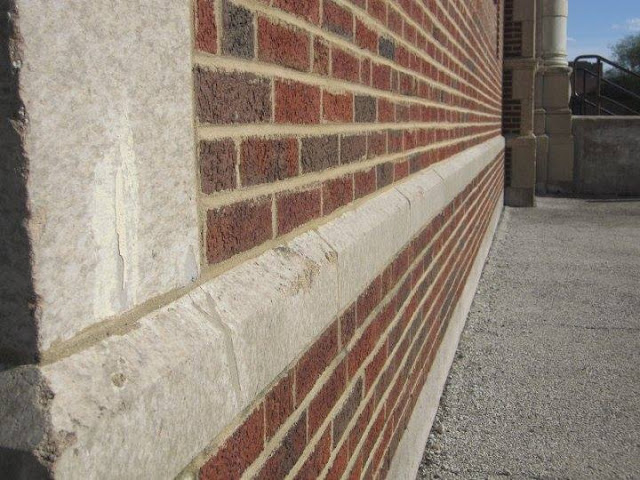
Chicago Public School exterior wall with a ledge used to play Pinners.
Some kids called the game "Ledge," "Bounce Out," or "3-Outs" but those were determined by the school they attended. The universal name for the game throughout the city was "Pinners."

Terminology
Double Play; A play in which the fielder catches the ball creating an out, the fielder may throw or lob the ball so that it bounces once on a step that is parallel to the ground. The fielder may move to catch the ball after the throw. The fielder who did not catch the ball for the original out may move before the ball has been thrown in order to catch the ball for another out. The throw to the step may hit the part of the step that is parallel to the ground once but may hit a part of the step that is perpendicular to the ground as well, the ball, however, is a dead-ball if on the throw it bounces of a backstop before being caught again.

Rush Hour; A play in which the ball is out of play, either by foul ball, home run, or a misplay by the fielder, the fielder must throw the ball to the batter from where he stands or the batter may call stalling if the fielder is walking before he has thrown it in.

Rushies: A one-handed catch, leading to an automatic three outs. The player catching the ball with one hand is allowed to run towards the batter's box and throw the ball while the opposing team is in transition from offense to defense.

Stalling; When called the batting team is awarded a single without the batter, who would be up, having to sacrifice their turn in the order. 

Compiled by Dr. Neil Gale, Ph.D.

The Lunchtime Theater - Illinois Railway Museum's Railroad Crossing Signals.

THE DIGITAL RESEARCH LIBRARY OF ILLINOIS HISTORY JOURNAL™ PRESENTS
THE LUNCHTIME THEATER.

Illinois Railway Museum's Railroad Crossing Signals.


Wednesday, January 11, 2017

The 1893 Chicago World's Columbian Exposition Observation (Ferris) Wheel.

The original Ferris Wheel, sometimes called the Observation Wheel or the Chicago Wheel, was designed and constructed by George Washington Gale Ferris Jr. and was the centerpiece of the 1893 World's Columbian Exposition in Chicago, Illinois. 

Both Ferris and his associate W. F. Gronau recognized the engineering marvel the wheel represented: a giant wheel that would turn slowly and smoothly without structural failure had never before been attempted.

For its inaugural run, no cars had yet been attached. The workmen, however, climbed the structure and settled themselves on the spokes to the accompaniment of cheers from an audience of fair employees who had gathered to watch the momentous event. After the wheel had completed its first rotation, Gronau deemed the test a success. "I could have yelled out loud for joy."

Ferris himself had not been able to attend the launching of his invention. I received a telegram that evening: "The last coupling and final adjustment were made, and the steam turned on at six o’clock this evening. One complete revolution of the big wheel made everything work satisfactorily. Twenty minutes were taken for the revolution ─ I congratulate you upon its complete success midway is wildly enthusiastic."
The Ferris Wheel's statistics begin with the two 250-foot Wheels with 36 enclosed passenger cars hanging between them. The size of streetcars ─ 27 feet long, 13 feet wide, and 9 feet high ─ with large observation windows barred by iron safety gratings, each car was fitted with 40 swivel chairs and had room for 20 more standing passengers for 60 passengers. 
The Wheel rotated on a 142,351 pound (71 tons), 45½ foot axle comprising what was, at that time, the world's largest 'hollow forged' axle weighing 89,320 pounds, together with two 16-foot-diameter cast-iron spiders, for the spokes, weighing in at 53,031 pounds.
Each car weighed 26,000 pounds (13 tons). Stepped platforms at the Wheel's base enabled six cars to be loaded and unloaded at a time. Fully loaded, the Wheel's maximum capacity was an astounding 2,160 passengers. Each car carried a World's Fair employee to monitor the passengers' health and well-being.
The Ferris Wheel took 20 minutes to make two revolutions (your ride), the first involving six stops to allow passengers to exit and enter and the second a nine-minute non-stop rotation, for which the ticket holder paid 50¢... the exact cost as the entrance fee to the World's Fair.
Steps to the platform to enter and exit the Ferris wheel, six cars at a time.
Note the American Banners draped under the Ferris wheel car's windows. 
It was instantly hailed as the "Eighth Wonder of the World."
In 1893, skyscrapers were in their infancy. The 264-foot-high Ferris Wheel stood just a bit shorter than the tallest building in North America then, Chicago's Masonic Temple, completed in 1892, which was 302 feet high (demolished in 1939).
The Wheel was outlined at night by 1,400 light bulbs and reportedly could be seen from 50 miles away.

The wheel closed in April 1894 and was then dismantled and stored until the following year, when it was rebuilt for the opening of Ferris Wheel Park in 1896. Ferris Wheel Park was located in Chicago's Park West neighborhood of the Lincoln Park community at 1288 North Clark Street (today: 2600 block of North Clark Street).
ACTUAL FILM FOOTAGE
A Lumière Film: Chicago. Grande Roue (1896)
The Ferris Wheel at Ferris Wheel Park.

Next, it was dismantled and rebuilt for a third and final time for the 1904 Louisiana Purchase Exposition World's Fair in St. Louis, Missouri. It was demolished there in 1906 and is rumored to have been blown up and buried in Forest Park in the City of St. Louis.


By Dr. Neil Gale, Ph.D.


For an in-depth history of the 1893 World's Columbian Exposition's Midway Plaisance (the birth of the amusement park), where the Ferris wheel was the main attraction, check out my book "The Midway Plaisance at the 1893 World's Columbian Exposition in Chicago."

My Digital Research Library of Illinois History® is the most extensive collection of 1893 World's Fair antique books, documents, and research papers online at the 1893 World's Fair  Library.

The Lunchtime Theater - Chicago Memorial Day Massacre of 1937, in two parts.

THE DIGITAL RESEARCH LIBRARY OF ILLINOIS HISTORY JOURNAL™ PRESENTS
THE LUNCHTIME THEATER.

Chicago Memorial Day Massacre of 1937 - part 1

Chicago Memorial Day Massacre of 1937 - part 2

In the Memorial Day massacre of 1937, the Chicago Police Department shot and killed ten unarmed demonstrators in Chicago, on May 30, 1937. The incident took place during the "Little Steel Strike" in the United States. The incident arose after U.S. Steel signed a union contract but smaller steel manufacturers (called 'Little Steel'), including Republic Steel, refused to do so. In protest, the Steel Workers Organizing Committee (SWOC) of the Congress of Industrial Organizations (CIO) called a strike.

On Memorial Day, hundreds of sympathizers gathered at Sam's Place, headquarters of the SWOC. As the crowd marched across the prairie towards the Republic Steel mill, a line of Chicago policemen blocked their path. The foremost protesters argued their right to continue. The police, feeling threatened, fired on the crowd. As the crowd fled, police bullets killed 10 people and injured 30. Nine people were permanently disabled and another 28 had serious head injuries from police clubbing plus another 100 others were badly beaten with clubs.

Years later, one of the protesters, Mollie West, recalled a policeman yelling to her that day, "Get off the field or I'll put a bullet in your back." No policemen were ever prosecuted.

A Coroner's Jury declared the killings to be "justifiable homicide". The press often called it a labor or red riot. President Roosevelt responded to a union plea, "The majority of people are saying just one thing, {A plague on both your houses}." In the wake of the massacre, the newsreel of the event was suppressed for fear of creating, in the words of an official at Paramount News agency, "mass hysteria."

Today, on the site of Sam's Place stands the union hall of the United Steelworkers and a memorial to the 10 people who died in 1937.

Lost Towns of Illinois - The Village of Forksville, Illinois.

Originally named the Forks before any houses were built. Sometime later it was officially named Forksville for its location at the fork of the McHenry-Chicago and Little Fort (Waukegan) roads, in Lake County, Illinois. At the beginning of the Village's settlement, there were about 150 people living there.
Huson & Booth owned the only general store in Forksville. F. Gale owned the hotel which had a handful of rooms. There were three lime kilns that burn over 3,000 bushels a year. The village had two boot and shoe makers that were owned by J. M. Delaree and David Lewis. Forksville had one cooper shop which was also owned by D. Lewis, and one blacksmith shop. Dr. Malindy was the physician and S. S. Hamilton, Esq, was an attorney. Considerable winter wheat was raised in the village.

The Forksville post office was established on March 24, 1848 with David Lewis being appointed the first postmaster. Forksville was surveyed and laid out October 12, 1849. 

David Lewis served as postmaster until May 12, 1851. The post office was renamed to Volo on November 27, 1868 (possibly at the suggestion of Greek immigrants who named it for the town of Volo (Volos) in eastern Greece. There were a total of thirteen postmaster appointments until the post office was discontinued on June 14, 1904, and the mail was ordered to be sent to Round Lake.

The June 7, 1851, Gazette announced that the road was planked to Hainesville, and that it was planned to go on six miles further to Forksville. Seven hundred thousand feet of planks were on hand for the extension.

Before 1868 the Forksville log school-house gave way to a frame one which was in use until about 1915.

Compiled by Dr. Neil Gale, Ph.D.