Ronald Wilson Reagan was born in Tampico, Illinois, on February 6, 1911, in an apartment above a bakery. The First National Bank purchased the bakery in 1919 and continued as a Bank until the 1930s. The apartment where he was born has been refinished to look as it did when he was born there. The bank has been restored to look like a working bank of the early 1900s. The store located to the South of the Bank was originally a grocery store and now houses the gift shop for the Reagan Museum.
When Ronald was 4 months old, the family moved from the apartment to a house on Glassburn Street. The house is located across the street from Reagan Park (known initially as Railroad or Depot Park). The Reagan family moved into their apartment at 834 East 57th Street, Chicago, Illinois, in January of 1915. The apartment building was near the University of Chicago. The University bought the building in 2004 and demolished it in 2013.
832-834 East 57th Street, Chicago, Illinois
They'd come to the city from the western Illinois village of Tampico. Jack Reagan, Ronald's father, got a job selling shoes in the Loop. His wife, Nelle, stayed home with the two boys, 6-year-old Neil and little Ron–called "Dutch"–who was going on 4. (Some sources imply the Reagans lived at two different places in Chicago, but most sources just give one Chicago residence for them.)
Ronald Reagan's Birth Place.
Ronald Reagan was born on the 2nd Floor of this Historic Building.
Ronald Reagan's Birth Room.
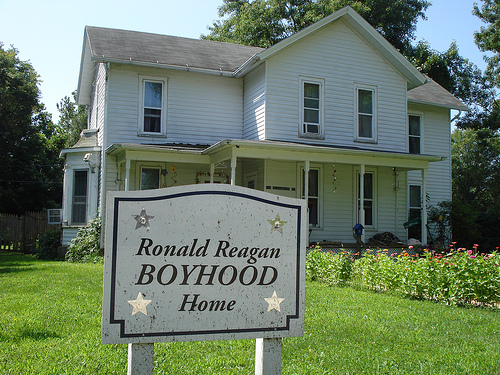
Reagan's Tampico, Illinois, Boyhood Home.
Ronald and Neil (Ronald's older brother; nicknamed "Moon" derived from the "Moon Mullins" comic strip character. Neil was a director of the hit radio series, "Dr. Christian," with Jean Hersholt for nearly 20 years. He also directed his brother Ronald in the television series "Death Valley Days.") played on a cannon in the park as young children. He referred to the park and the cannon in several of his stories. When he was 4 years old, the Pitney Store, where his father, Jack Reagan, worked, was sold, and the Reagans moved to Chicago, where Mr. Reagan worked for a short time at the Fair Department Store. The family then moved to Galesburg, where Mr. Reagan was employed as a store clerk.
Ronald Reagan's 4th Grade Class photo in 1920 (Ronald is in the second row at the far left with his hand on his chin).
While there, Ronald learned to read at 5 before starting school. He attended Silas Willard School in Galesburg and skipped grade 2. The family then moved to Monmouth for a short time. They were called back to Tampico for Mr. Reagan to work for Mr. Pitney, who had acquired his old store again. The family lived above the Pitney Store until moving to Dixon in December 1920. HISTORY OF THE VILLAGE OF TAMPICO Tampico is a village located in Tampico Township, Whiteside County, Illinois. As of the 2010 census, the town had a total population of 790, up from 772 at the 2000 census. The area containing the future Tampico Township was a slough. The first non-aboriginal settlers arrived in 1852. The township of Tampico was established in 1861. In 1863-64, the area was drained. The local railroad went into service in 1871. In June of 1874, a tornado struck and destroyed 27 buildings: FROM THE STERLING IL STANDARD NEWSPAPER; Thursday, June 11, 1874. TAMPICO IN RUINS - During the heavy storm that prevailed here on Saturday evening, about 10 o'clock, a whirlwind passed over a portion of this county, going over Lyndon high in the air, touching Prophetstown slightly, and working ruin in the village of Tampico. As far as we know, most of the town is destroyed or blown from foundations. The two elevators were entirely demolished, and the passenger depot and many dwellings were demolished or lifted from their foundations. Mrs. J. G. Banes had her leg broken in two places. An infant of Mrs. Dow's was reported to have been blown away and not found until morning, when it was discovered in a pile of rubbish, unhurt and fast asleep. Miss Maria Banes had her face bruised and a severe concussion of the brain - severe, recovery doubtful. Mr. J. G. Banes and several other persons were somewhat injured, but none seriously. Mrs. Piersall's shoulder was dislocated, and Mrs. Gates's was the same. The following buildings are destroyed: one elevator with a capacity of 25,000 bushels, one smaller elevator, and a hay press. Mr. Williams' residence, A. Bastian's house, two houses of Humphrey estate, A. Gurnan's house, J. G. Banes' hotel, M. E. Church, C. Down's house, Gates' Pump Factory, F. Smith's house, G. W. Piersall's house, Haskins' shoe shop, Collins and Maxfield's blacksmith shop. Among some of the injured are Merritt & McGee's store, Geo. Dee's house, E. W. High's house, McMillan's tenement house, Davis', Dee's and Burke's stores, and numerous others we cannot particularize. Total loss is estimated at $25,000 to 30,000. A great many of our citizens went over on Monday and Tuesday. Dr. Anthony reports having visited many of the injured and that all are doing well. With his usual enterprise, James Adams took his photographic apparatus over and obtained several fine views of the ruins, which he has on sale at his gallery. FROM THE STERLING IL STANDARD NEWSPAPER; Thursday, July 16, 1874 RE-BUILDING - We are pleased to notice that our neighbors of Tampico are putting forth strenuous efforts to replace the buildings torn down and destroyed by the tornado about a month ago. The elevators are being replaced, and new buildings are growing everywhere. The Tampico businessmen possess vim and energy and will undoubtedly succeed. The committee estimated the town's loss by the tornado at $70,000. The Village of Tampico was incorporated in 1875.
East Side of Main Street (1905) showing the C. F. Sippel Building before 1910. The Sipple Building is at 107 Main Street on the east side of the street.
East Side Main Street P.H. Likes Grocery Store.
Main Street Looking North J.C. Simpson and Company's Lumber Yard.
West Side Main Street showing the Smith Bros. Hardware is on the left, and McCormick Farm Tools is on the right. These buildings were torn down to make room for the new bank building.
M.S. Whipple Repair Shop.
Hotel Pitney House was located on the northeast corner of Market and Main Streets.
Aldrich Millinery Shop. On the west side of Main Street is the Aldrich Millinery Shop (L.L. Higday owned the Millinery shop until she died in 1895. Miss Ristow bought the inventory).
Ed and Desmonia "Dessie" (Scott ) Winchell and their daughter Lillian are at home.
Cyclone of November 25, 1908 damage.
Main Street 1940s.- (east side) Tampico Theater; Royal Blue Store (now the Historical Society); John Wayne's Clothing Store (west side); Opera House/Billiards Parlor (west side); Cain Drug store (west); Millinery Shop (west), Tinks bar (west).
Main Street Looking South in the later 1950s. Vera's Lunch Cafe (right) and Tampico Super Market (left).
East Side Main Street 1950s.
FROM THE TAMPICO TORNADO NEWSPAPER; Friday, December 5, 1908
CYCLONE STRIKES TAMPICO - on Wednesday, November 25, 1908, a Twister Goes Through the Eastern Part of the City and Demolishes Several Barns. A cyclone struck the eastern edge of Tampico last Wednesday evening at about 7 o'clock and left a mass of wrecked, demolished, scattered barns and outhouses in its wake. Several barns were destroyed entirely, but very fortunately, the storm was not strong enough to ruin any dwellings further than to rack them or tear shingles from them. No one was injured, and no livestock was killed. The total loss will reach about $1500 or $2000, most of which insurance covers. The storm came without warning other than the terrible roar accompanying twisters. This was heard by several who started for their cellars but could not reach them before it was all over. O. D. Olsson, who happened to be outdoors, saw and heard the funnel-shaped cloud coming and said it made a noise like a hundred trains. He recognized what it was and ran for the house. Others also heard and saw the cloud, which they described as the same. The storm's course was from the southeast, striking the eastern part of the village in an erratic course. Its first effects were felt at Robert Hellier's farm about a mile south of town, and the last whack it took was in the northeastern part of the village at the residence of Mrs. Annie Peterson, occupied by Fred Wensel.
1936 Farm Ownership Atlas.
Farm & Feed House Museum.
VIDEO
History of Tampico by Hugh Downs of 20/20 Broadcast in 1982.
When Maud Slye began her work on the pathology of cancer, very few scientists believed that cancer was a genetic disease. Most experts thought that human cancers were either caused by viruses-like The Rous Sarcoma Virus, which had recently been implicated as the cause behind tumors in chickens, or a side-effect of rapid industrialization. Maud Slye, an American pathologist, was born in Minneapolis, Minnesota. A historian of women and science wrote that Slye "'invented' genetically uniform mice as a research tool." Her work focused on the heritability of cancer in mice. She was also an advocate for the comprehensive archiving of human medical records, believing that proper mate selection would help eradicate cancer. During her career, she received multiple awards and honors, including the gold medal of the American Medical Association in 1914 and the gold medal of the American Radiological Society in 1922.
Slye received her undergraduate training at the University of Chicago and Brown University. While at the University of Chicago, she supported herself as a secretary for University President William Rainey Harper. After a breakdown, she completed her studies at Brown in 1899. After teaching, she began her postgraduate work in 1908 at the University of Chicago, performing neurological experiments on mice. She would remain at the University of Chicago for the rest of her career. After hearing of a cluster of cattle cancers at a nearby stockyard, she changed the focus of her research to cancer. Slye raised—and kept pedigrees for—150,000 mice during her career. In 1913 she first presented a paper before the American Society for Cancer Research. In 1919 she was selected as director of the Cancer Laboratory at the University of Chicago. In 1922, she was promoted to assistant professor and became an associate professor in 1926. She retired, as a professor Emeritus of Pathology, in 1945. Her belief that cancer was a recessive trait that could be eliminated through breeding caused clashes with fellow scientists, including C. C. Little.
Not unlike Madame Curie, who worked under adverse conditions to bring untold benefits to the world through the discovery of radium, Dr. Maud Slye, University of Chicago research scientist, has been tracking down methods of controlling cancer, for the past 38 years. Working in barren quarters on a tiny fellowship, Dr. Slye has observed the disease in 150,000 mice, all of them dead now because the doctor did not have the funds to feed them, and planed to apply her findings to humans. But on July 1st Dr. Slye will turn 65, the retirement age for the University's professors, and will be forced to vacate her quarters. "I have proved that cancer can be controlled in mice. All I want now is the time and a place to continue my work, and I want to continue in this place. If I can just be left alone here to go with my work, that is all I ask of life," the doctor says. (1933)
Slye was devoted to her work. A 1937 Time account of her behavior at a science convention described her as "high-spirited" and quoted her as saying: "I breed out breast cancers. I don't think we should feel so hopeless about breeding out other types. Only romance stops us. It is the duty of scientists to ascertain and present facts. If the people prefer romance to taking advantage of these facts, there is nothing we can do about it." Reluctant to leave her mice to the care of her assistants, she once went twenty-six years without a vacation. She never married and spent her retirement reviewing data from her research. She is buried in Oak Woods Cemetery. Compiled by Neil Gale, Ph.D.
The Mill Bridge Roller Rink at 8027 West Ogden, Lyons, Illinois, opened in the late 1930s when a man named Jachim "Jokes" Fonter and his first wife, Mary, converted an old Hudson Car Dealership and their service center into a popular destination for children, teens, and their parents. Both sets of the couple's parents ran concession stands at the rink, and another man known as "Red" was the bouncer. Red was so adept on wheels that he skated backward the whole evening, swooping in to help skaters who fell by stomping his skates loudly so people would know to maneuver around them. Regulars knew to expect well-dressed crowds and well-behaved skaters. Fonter didn't tolerate mischief in his rink, forcing skaters who broke the rules to sit in a wooden booth cordoned off with a rope and known as the penalty box. There was a Capuchin Monkey, the type that Organ Grinders typically had.
Many skaters had their own indoor skates. In hard-sided cases, they brought their skates to the rink. Those who didn't own skates rented them at the rink: white high-tops for the girls and black, lower-cut styles for the guys. Unlike many of the former roller rinks that people regularly write in to reminisce about, the Mill Bridge stayed open past roller skating's heyday of the 1940s, 50s, and 60s. Fonter and his first wife separated, but the rink remained open. He and his second wife, Nancy, lived above the rink with their son. But by 1990, skating crowds were nowhere near what they once were. Fonter, who struggled with Parkinson's disease, decided to close the rink and put the building up for sale.
On Mother's Day 1993, the roller rink building caught fire, going up quickly because of all the floor polishes still in its back room. The Fonter's had stopped insuring the building years earlier because they couldn't afford the premium. Fonter died in 1997. Visit our Souvenir Shop.