Thursday, August 17, 2023

Chicago Tribune, Port of Chicago Article, April 18, 1849 (First Newspaper).

In 1849, there was quite a bit of shipping traffic in Chicago.

VIA LAKE MICHIGAN
ARRIVED
April 20, 1849:
Schooner, J.C. Spencer, Muskegon—80 meters (262.5 ft) lumber.

April 23, 1849: 
Brigantine, Helfenstein, Milwaukee—ballast
Schooner, Amanda Harwood, Grand Haven—90 meters (295 ft)
Schooner, Bowen, Kalamazoo—35 meters (115 ft) lumber, 16 meters shingles (52.5 ft)
Schooner, Muskegon, Muskegon— 70 meters (230 ft)
Schooner, Niagara
Schooner, Ronicus
Schooner, Telegraph, Grand Haven—100 meters (328 ft) lumber.

CLEARED
April 21, 1849:
Sloop Michigan, Buffalo—343 hides, 8 pkg sundries, 752 barrels flour, 179 barrels pork
Propeller Princeton, Buffalo—1140 barrels beef, 200 hides, 30 pkg furs


VIA THE CANAL
ARRIVED
April 21, 1849:
Shakespeare, Joliet

April 23, 1849:
Granger, Athens (renamed Lemont in 1850)
Wm. Giles, Athens (renamed Lemont in 1850)

CLEARED
April 21, 1849:
Calaract, LaSalle
Diamond, LaSalle
General Davis, LaSalle
General Fry, Lockport
Hollister, LaSalle
Indians, LaSalle
St. Louis, LaSalle
Wasp, Joliet

April 23, 1849:
Chicago, LaSalle
J.T. McDougal, Joliet
Wm. Giles, Athens (renamed Lemont in 1850)

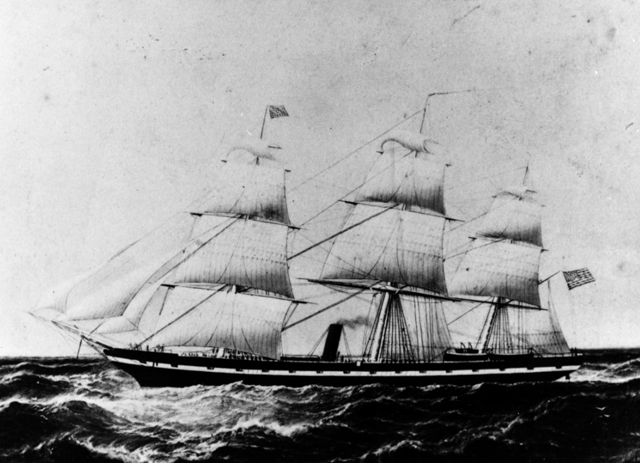
Brigantine - A brigantine is a two-masted sailing vessel with a fully square-rigged foremast and at least two sails on the main mast: a square topsail and a gaff sail mainsail (behind the mast). The main mast is the second and taller of the two masts.
Propeller - The first propeller ship was invented by John Ericsson in 1836, and the first commercial propeller ship was the SS Archimedes, which was launched in 1838.
Schooner - Schooners were used to transport cargo along the coasts and between islands. They were particularly well-suited for this purpose because they could sail close to shore and in shallow waters. This picture is a replica of the 1847 C.W. Lawrence.
Sloop - A sloop is a sailboat with a single mast typically having only one headsail in front of the mast and one mainsail aft of (behind) the mast. Such an arrangement is called a fore-and-aft rig and can be rigged as a Bermuda rig with triangular sails fore and aft or as a gaff-rig with triangular foresail(s) and a gaff rigged mainsail.


Compiled by Dr. Neil Gale, Ph.D.

Wednesday, August 16, 2023

1856, September 8th, Fire at the Chicago Baltic House Hotel Stables.

This illustration is a visual aid.


The alarm of fire at about 10 o'clock in the evening was occasioned by the burning of the stable attached to the Baltic House, owned and occupied by Mrs. Connor, on Wells Street, just south of Van Buren Street. The loss on the stable was about $400, and the damage to the hotel from scorching and the removal was some $400 additional. No insurance.

Compiled by Dr. Neil Gale, Ph.D.

1856, April 13th, Two Persons Burned to Death, Chicago.

A small frame building on Peyton Street, near the North Branch of the Chicago River, was burned up Sunday night, and an Irishman and his wife were consumed by the building. The remains of the bodies were taken out after the fire and placed in coffins by the coroner. 
This photo is a visual aid. 1856 House Totally Destroyed by Fire.


Another Irishman who boarded in the house, and a boy some 14 years old, made a narrow escape by jumping out of the window. The parties who were burned were recently married, but we did not learn their names. The woman was formerly a widow named Crimmis, and it was her boy who escaped. The origin of the fire is not known, as all in the house were asleep.

Compiled by Dr. Neil Gale, Ph.D.

1856, April 7th, Chicago Manufacturing Co., Fire Total Destruction.

Monday forenoon, the Oil Manufactory, situated on the South Branch of the Chicago River, owned by the Chicago Rosin Oil Manufacturing Company, was totally destroyed by fire. About $10,000 worth of stock was destroyed, and the loss is approximately $20,000 ($719,000 today). There was no insurance.
Chicago Rosin Oil Manufacturing Company. This photo is a visual aid.


The fire was caused by the breaking of one of the large kettles, from which a large quantity of inflammable material came in contact with the furnace fires and then communicated the flames to the building. The stock was owned by Hugh Maher, F.C. Sherman, F.T. Sherman, C. Marsh, Dr. Morse, Richmond & Co., and C.B. Brown.

Compiled by Dr. Neil Gale, Ph.D.

Tuesday, August 15, 2023

1856, January 19th, Brewery and Dwelling Burned, Chicago.

The fire alarm on Saturday evening at about 9 o'clock was caused by the burning of a large brewery, "Bier Halle," dwelling and stable near the Illinois Central Railroad Engine House and Machine shops in the southern part of the city. The buildings were owned by Mr. Best and occupied by Mr. Siab. 
The Wein & Lager Bier Halle (The Wine & Beer Hall), a Bavarian-style (German) pub, at 513 South Halsted Street (1304 S. Halsted today), Chicago.


The firemen were promptly on the ground: but the flames spread with great rapidity; owing to a strong north-eastern wind blowing at the time and great difficulty being experienced in procuring water, the buildings were entirely destroyed. We have heard the loss variously estimated from $10,000 to $15,000. The fire is supposed to be the work of an incendiary.

Compiled by Dr. Neil Gale, Ph.D.